This blog has turned into an occasional journal and it is interesting to read backwards and discover things about myself a few years ago.
I have been writing, for an assignment in one of my classes at Rice, blog posts about my own thoughts on consumption, especially my own modes of consumption. The professor is one of the foremost theorists of a new strain of thought called Object-Oriented Ontology, or OOO. It is one of the new theories of Speculative Realism, an attempt to re-orient our study of literature to get through post-modernism and post-structuralism. It is incredibly rich and complicated, but it is doing several things that I love: allowing objects to exist, destroying anthropocentrism (while keeping necessary awareness of anthropomorphism!), and allowing objects to interact and impress themselves upon us (using, it seems, Alfonso Lingis's ideas of the Imperative). It is, oddly enough, re-opening a manner of discussing the agency of objects that is reminiscent of the medieval. Although OOO is happening completely within the possibility space of the post-modern, it seems to me to be an excellent language with which to express pre-modern ideas to post-modern people. I am, however, wary, because there are some conclusions and premises that it has buried within it that do not share a basis with Christian Orthodoxy. In the past, we have seen, attempts to express the Faith through the language of the modern or postmodern has led to sever misunderstandings about what the Church teaches. But then again, theology has its own language inherited from scholasticism that makes little sense to modern or postmodern people, even though it is rich in meaning and implication. The problem of translation insists itself upon thought. When you translate something, the original is lost a bit, but some of it remains, I believe. But it remains not because of an ability inbuilt in the human mind but by Grace. Christ grants us the ability to make human language and structures meaningful, although they can never express the essence of an object. The Myth of Christ (and by that I mean Myth in the Tolkienian sense, not modern parlance of 'untrue') is the perfect structure that makes the human, shaky structures solid and true. On Christ the solid rock I stand, all other ground is sinking sand. He that builds his house upon stone... The paradox that untangles all other paradoxes, says Chesterton. The knot that undoes all other knots. The sacrifice which renders all other sacrifices unnecessary. The Eucharist is the center of this, the body, soul, and divinity of Christ made present and mysterious for us so that we may constantly renew our covenant and awareness of the incompleteness of our existence. God's means of Grace made possible through the Church. The sword that cuts through the Gordian knot.
But this is not Speculative Realism--it is the Faith. And although OOO allows for beauty back into the world, it is difficult to judge the ethical status of such beauty. The temptation is to say there is no ethics.
OOO is a mystical ontology. As such, it cannot be reconciled with traditional ethical statements and judgments. This was explored by another professor of mine, Jeffrey Kripal, whose conclusion--which I find absolutely convincing--in Crossing Boundaries: Essays on the Ethical Status of Mysticism was that there is no necessary relationship between the mystical and the ethical, and to the degree which that mystical view expresses itself as monism, it becomes increasingly problematic for societies, cultures, and ethical judgment. This helps explain the constant tension within the medieval Church between the mystics and the ethics of the cultural Church. Now, I believe that both mysticism and society are necessary for the human to live a fulfilled life appropriately qualified by life's incompleteness, but we cannot ignore the fact that a society built on a mystical ontology is inherently unstable.
Then how can we build a Christian society, as Christ and Orthodox belief demand that we view the world through the eyes of Christ, an inherently mystical assertion? We must be mystics to some extent; in constant contemplation and prayer, with an unending love for those around us, a respect for all other beings (including, I would assert, bacteria and wheat and hammers and ideas). We must recognize that Original Sin means that we live a life fundamentally subtended by violence towards the Levinasian Other. Our very existence is based in Sin. How terrible it seems, and how we should just then fade away into God! Except that to do that would be futile and sinful in itself, just as incomplete. No, we must rely on Grace to make us sinless, though we consume the flesh of animals and exhale toxins and misuse resources and dissipate energy uselessly. We must remember that God does not want us to be right, but humble. An appropriate remembrance of our Original Sin makes us constantly aware that though we make ethical judgments all of the time, we also war and consume and poison. We are always in the wrong in the sight of God, says Kierkegaard.
But this is a mystical view of the world, a mystical conclusion of the Christian existence, that we are constantly beating Christ and nailing him to the cross. Monks are made to be aware of this, and we should always be aware of this as well.
But ethically this is a dangerous assertion. Ethically, if we are always in the wrong, we become paralyzed, feel that all of our judgments are wrong, do things that are manifestly idiotic and terrifying, break down the walls of society, dissolve our subjectivity into nothingness, and get everything immensely wrong. A life lived in a mystical state would not be an ethical one. You would constantly be failing and also bringing about even more distress by your insistence of reversing society's "norms." So we must also assert that war is Just sometimes, that to kill your family is worse than killing the stranger invading your household, that to chop the head off a poisonous snake is Better than letting it bite a woman. That, by extension, there is good art and bad art, moral and immoral architecture, and moral and immoral sexual behavior. All this we must assert even though, at the bottom of it all is the awareness that this ethics is somehow wrong, that this social ethics is not intellectually or religiously supportable to its core but is rather based on illusions. We must assert this--why?
Because the Grace given to us by God through Holy Mother Church allows us to make human structures, these incomplete and seemingly illusory structures, Real and Meaningful.
But we must be careful, for we are called to not only support communities and cultures but also support and endorse the dignity of all human persons, and by extension, the dignity of all objects, and must recognize our fundamental violence towards them as well as the incredibly insistent radical love of them that blossoms within our encounter with them, the empathy that results when you see a complete stranger crying, the preciousness of a flower, the outpouring of shattering adoration for every bee.
And so we stand, as Christians, at this crossroads, able to express the two fundamental forces of human life: judgment and the awareness of our mind's inadequacy to judge, preferential love and unconditional love, specific desire and general desire, the particular and the abstract. Both are needed, both are always present, and the elimination of one leads to great wrong being done. For if we merely assert the judgment, the particular, the preferential treatment, then we are on the chain of being and will be heartless in our selfishness, like Ayn Rand or the SS, or like the child that smashes sandcastles and delights in killing squirrels. And if we are merely abstracted and general, unconditional and mystical, we will do great harm to the particular, like those who watch their wives raped standing idly by, wishing not to judge, or those who create art that disgusts and torments and adds no beauty to the world merely because they do not believe that beauty exists, or those that allow their children to be sexually and socially immoral in an attempt to love them unconditionally. Both sides of the spectrum are equally disgusting and incomplete. Both sides of the spectrum are inhumane and ungodly. The Church insists that both be held in tandem, and the sun-like heat of the Eucharist melts them into one substance, an alchemical fire that unites and purifies them, the light that shines on both. We fail but God still is present in our bodies through the Eucharist. We retreat to the monastery but God still insists that we live in community, with hierarchy. We cannot escape the need to live in both worlds, in the Presence of God and the presence of man, in the life of the soul and the life of the body, which turn out not to be two separate things but one impossible fusion made possible by the fact that the eternal God manifested in a temporal body through Christ our Lord.
Amen.
Friday, November 22, 2013

Thursday, April 18, 2013
Hiatus
I'm taking a hiatus from the New Masculinity posts. I have massive writer's block concerning them, and it's preventing me from posting anything.
Something that has been concerning me lately is more serious and concerns my work as a religious studies student. That concern is the problem of modernity. I will posting more about that soon.
On an unrelated note:
Anya (my dear friend) told me that I close-read people, not texts. I hope that's true.
Brittany (Nick's wonderful girlfriend) called me a host looking for a party. I hope that's true.
Thomas (friend and former roommate) told me I was a curmudgeonly old bastard. I think that's true, too, but I wish it wasn't. But other people have called my a grumpy old bear and other such things. There is definitely a theme.
Something that has been concerning me lately is more serious and concerns my work as a religious studies student. That concern is the problem of modernity. I will posting more about that soon.
On an unrelated note:
Anya (my dear friend) told me that I close-read people, not texts. I hope that's true.
Brittany (Nick's wonderful girlfriend) called me a host looking for a party. I hope that's true.
Thomas (friend and former roommate) told me I was a curmudgeonly old bastard. I think that's true, too, but I wish it wasn't. But other people have called my a grumpy old bear and other such things. There is definitely a theme.
Sunday, April 14, 2013
The Man Returns... Part IIa (continued, shortened)
I have been operating with my three-part hipster classifying system ever since I wrote the previous post.
It's not perfect...
but it's really good.
Keep in mind that what I'm interested in is how people relate to their cultural inheritance.
The three levels of hipster:
Level 1: Original hippies, beatniks, and other early counter-cultural movements
Level 2: The late nineties hipster we have come to know so well, the obscure band-loving, ironic, "vintage" wearing, postmodern aesthetes of various stripes.
Level 3: Completely sincere youth with no cultural allegiances, but aesthetically sympathetic to old American and European cultures.
Type 1 is fading out. They're in control now, and pulling cultural (and monetary) strings. They intentionally left their culture behind for various reasons that I cannot explain right now. They were, however, completely sincere about what they were doing, and despite some brain damage and some very weird ideas about religion, they tend to be great people to hang around. Their domain is social issues. That is where they are most active.
Type 2 is still going on strong. Sometimes they are sons and daughters of the type 1 hipster, but more often they are the children of the yuppie-hippie fusion (yuppie monetary values, hippie social values) that some have named the Bobo (the Bohemian Bourgeoisie). They, again, are the products of the United States school system. They have only passing, wikipedia-like knowledge of history and culture before their time. I could go on and on about them, but I shan't. You know of whom I speak. Their domain is the arts--mostly notably music. Performing art is their specialty, though--but installment art is another place to watch them gather.
Type 3 is on the rise, mostly in the food and drink industry. If the performing arts is the domain of the type 2 hipster, then crafts is the domain of the type 3 hipster. Now, these hipsters can often still be incredibly obnoxious (think Portlandia... "is it local?") but there are many (Mast Bros. Chocolate, for instance) that although they are really unnecessarily, unhelpfully obsessive about certain things (like whether a food is "organic" or "local", even though those denominations rarely indicate a real difference in quality), most of them really like food. Not because it's 'hip,' like Crystal Castles is hip (because it's bad. Crystal Castles is bad. Type 2 hipsters love it because they can perform having better taste than you), but because good food is actually really good. Drinks are that way, as well, and in the craft beer movement, you find a lot of people that you would immediately categorize as "hipsters," but really they're just interested in making delicious things. Craftsmen and women as well, are making a come back. These hipsters (although they may have iPads), really are reacting against the ironic, detached, performative aesthetic of their type 2 peers.
Questions? Put them in the comments section.
I'd be happy to talk more about this, but I'd like to move on.
More importantly, two of my good friends just started blogs! Check them out at:
http://metoplay.blogspot.com/
and
http://andzeroatthebone.blogspot.com/
I have been operating with my three-part hipster classifying system ever since I wrote the previous post.
It's not perfect...
but it's really good.
Keep in mind that what I'm interested in is how people relate to their cultural inheritance.
The three levels of hipster:
Level 1: Original hippies, beatniks, and other early counter-cultural movements
Level 2: The late nineties hipster we have come to know so well, the obscure band-loving, ironic, "vintage" wearing, postmodern aesthetes of various stripes.
Level 3: Completely sincere youth with no cultural allegiances, but aesthetically sympathetic to old American and European cultures.
Type 1 is fading out. They're in control now, and pulling cultural (and monetary) strings. They intentionally left their culture behind for various reasons that I cannot explain right now. They were, however, completely sincere about what they were doing, and despite some brain damage and some very weird ideas about religion, they tend to be great people to hang around. Their domain is social issues. That is where they are most active.
Type 2 is still going on strong. Sometimes they are sons and daughters of the type 1 hipster, but more often they are the children of the yuppie-hippie fusion (yuppie monetary values, hippie social values) that some have named the Bobo (the Bohemian Bourgeoisie). They, again, are the products of the United States school system. They have only passing, wikipedia-like knowledge of history and culture before their time. I could go on and on about them, but I shan't. You know of whom I speak. Their domain is the arts--mostly notably music. Performing art is their specialty, though--but installment art is another place to watch them gather.
Type 3 is on the rise, mostly in the food and drink industry. If the performing arts is the domain of the type 2 hipster, then crafts is the domain of the type 3 hipster. Now, these hipsters can often still be incredibly obnoxious (think Portlandia... "is it local?") but there are many (Mast Bros. Chocolate, for instance) that although they are really unnecessarily, unhelpfully obsessive about certain things (like whether a food is "organic" or "local", even though those denominations rarely indicate a real difference in quality), most of them really like food. Not because it's 'hip,' like Crystal Castles is hip (because it's bad. Crystal Castles is bad. Type 2 hipsters love it because they can perform having better taste than you), but because good food is actually really good. Drinks are that way, as well, and in the craft beer movement, you find a lot of people that you would immediately categorize as "hipsters," but really they're just interested in making delicious things. Craftsmen and women as well, are making a come back. These hipsters (although they may have iPads), really are reacting against the ironic, detached, performative aesthetic of their type 2 peers.
Questions? Put them in the comments section.
I'd be happy to talk more about this, but I'd like to move on.
More importantly, two of my good friends just started blogs! Check them out at:
http://metoplay.blogspot.com/
and
http://andzeroatthebone.blogspot.com/
Monday, October 8, 2012
The Man Returns... Part IIa... HIPSTERS
We have covered the basic types of bro, the quintessential replacement-male in this day and age. But now it's time to get interesting.
Because I have limited acquaintance with "bros," I had to depend on those few experiences and many other sources on the internet and among my friends to be able to understand brodom. The analysis that follows, however, is largely my own, and may bring to light groups and nuances within groups that are not commonly discussed. All that I ask is that if you use my terminology, you cite me.
Just kidding. This is the internet.
R
On to the more nuanced (or at least more confusing) responses to the Great Emasculation.
The Hipster - A postmodern version of bohemian artiste dragged through the beat generation and hippie age, the hipster is a much-disputed modern phenomenon. I will not speak here about Pabst Blue Ribbon, American Spirits, Vinyl, and the hundreds of stores and establishments that now cater to 'hipster' taste (Anthropologie, American Apparel, Urban Outfitters). These are late forms of hipsterdom—the corporate response to what is essentially a facet of anti-corporatism. What I will discuss is the mind of the hipster.
The mind of the advanced hipster is as conflicted as modern educational values—indeed, it is the product of these values. In literary, art, and music theory, a process of negation is the norm—cultural products are deconstructed and revealed only to have social implications (not aesthetic ones). In following this "wisdom," hipsters associate all that they enjoy with whatever identity they wish to project, just as any human being. But because they wish to project the identity of being "postmodern"—which means the negation of aesthetics, and the pretense of 'seeing through pretenses,' making ambiguous everything concerning language and art, as well as a hundred thousand other things (Death of the meta-narratives being my favored summation, first put forth by Lyotard)—the objects, tastes, and actions they choose to endorse must have the component of being unpopular. Now, that does not mean that the things 'they' like are unpopular, just that they must be seen as being unpopular. Schoenberg, T.S. Eliot, and James Joyce suggested that high culture must be initiatory and inaccessible to the "masses" if it is to be useful and meaningful. Perhaps it is this attitude and the reactions to it which has resulted first in the mockery of aesthetic values in Duchamp's work, then in the paradoxical work of Warhol, and finally in the castrated, performative apathy of hipsters. The overused phrase to parody hipsters is "You probably haven't heard of it." Well, that's the point. If you had heard of it, and the hipster finds you pleasant, you are recognized as a fellow, but if you are found to be unpleasant, you are merely posing as an intellectual and/or the thing being discussed must no longer be important.
Their social positions reflect something even more telling about the modern American public school system. They are typically highly progressive, which is seen as being very counter-cultural (obviously they have not realized that counter-cultures are now the mainstream culture, while 'mainstream' culture, previously defined as Anglo-Saxon Protestant Americanism has now become countercultural, especially in the cities). They are normally rich white suburban persons who care deeply about the poor, minorities, and the environment in the most insipid, uninspired, and uniformed ways. They, whose place in society (indeed the possibility of their very unemployed, reactionary existence) is guaranteed by an enormous concentration of wealth in corporate capitalism, abhor that same system for the general reason that it is "oppressive and unjust." Their economic habits can be broken up into two groups: those hipsters that do nothing but buy from thrift stores and Etsy, and others that take the easy route and hit up Urban Outfitters and Anthropologie. They glory in the ugly, outdated, absurd, ill-fitting, jarring, shocking, and rude. They interlace very neatly with the Yuppies (described in the next post), but continue to deny that they are essentially yuppies. This denial of their socioeconomic and religiocultural origins is characteristic of course but is also a leftover from the "culture wars" that were fought between the Yuppies (cast as the 'mainstream') and the Hippies (cast as the 'counterculture'). However, neither the Yuppies nor the Hippies nor the yuppies nor the hipsters realize that the cultural wars are over. This is the most important point about these two groups—they define themselves in opposition to Christian, hierarchical society. The strangest thing about this is of course, they won the culture wars. But to accept that would be to accept death, as their entire identity is wrapped up in negation.
Edit, 11:21 pm: A revealing conversation with a friend of mine from Queens shed light on this topic. I think it is important to remember, in opposition to what I wrote above, that the individual choices of people who could be described as "hipsters" are not conscious choices of critique, but aesthetic fascinations. Above I refer more to the genesis of this attitude, which manifests still in 'intellectuals' at elite academies, but is on the wane due to the fact that most of these people are raised in a society that takes the rejection of the previous culture as a given. As my friend put it so well, what we could call a 'hipster' thinks "I wouldn't wish to impose a patriarchal idea of culture on anyone, but I think handlebar mustaches are cool and the only link I have to that culture, nominally my own, is an aesthetic link."
Keep in mind that all I say about hipsterdom has very little to do with the choices and opinions of an individual hipster, unless they themselves investigate their own cultural choices, as many university-going 'hipsters' do. And a small discussion of the word 'hipster' is also important. Note that people we would describe as hipster do not refer to themselves as such, and are aware of the word, but don't apply it to themselves or their social group—if they do, it's usually derogatory, meant to be understood as a critique of a persons motives rather than their aesthetic choices.
In fact, one could reconfigure the definition of hipster as a person who as either consciously rejected their idea of 'mainstream' society in order to individuate and reject the social and cultural valences of that mainstream society, OR one could define 'hipster' as someone who has grown up in a thoroughly post-cultural society to the extent that to find cultural identity, he manipulates the aesthetic detritus of an old society that he finds particularly fascinating or cool.
But are those people really hipsters? If you are inculturated into a self-conscious culture that repudiates its own previous culture, can you really be said to be counter-cultural? In other words, if you are raised in a society in which suits and bow-ties, horn-rimmed glasses, monocles, and tweed are already completely separated from their cultural meaning, is wearing those things a conscious rejection of their cultural meaning, or simply an aesthetic fascination? A fair question, indeed, and one that must be considered on a person-by-person basis. I suppose there are three general "generations" of hipsters.
1. The Antithesis - The first generation was characterized by a conscious rejection of Western (particularly American) culture, and an aesthetic tied to the rejection of these values. This can be understood in the context of the original meaning of the word hipster which is tied to the beat generation and underground intellectual jazz and post-form poetry clubs. You may characterize Andy Warhol as a hipster in many ways, including the embrasure of pop cultural artifacts as 'high' art (thus rejecting the idea of high art), and elaborate aesthetic play. And, in some ways I suppose, you may take hippies to be part of this generation, as those who originally "freed" American culture from the heavy hand of the Western intellectual tradition.
2. The Irony - The second generation are composed of those who, having grown up in the remnants of the old society, or grown up in the plastic, suburban corporate world that is in some ways the soulless shell of the old society, reject these late forms of society, most often after beingindoctrinated educated by the modern university. They affect, then, the aesthetics of hipsterdom still with an intent to reject, often with an intent to shock (especially their parents). These are hipsters are often characterized as androgynous (leading slowly back to our discussion of masculinity). They are very multicultural (as long as it's not their own culture), and project this "identity of repudiation" through their tastes, which project an enflamed sense of irony and deep-seated insincerity bordering on mockery.
3. The Re-Appropriation - The third generation hipster, whom my friend defended as not fitting within my system, grows up in a culture that has already rejected these things. The angsty rejection of the old society is, well, old hat. In a search for both belonging (which everyone needs), and individuation, they are forced into a quandary. Eventually, as my friend noted, all of the rejection of the first and second generation of hipster, finally terminating in apathy, must turn in on itself and manifest in aesthetic fascination. And so the androgyny and cultural irony of second-generation hipsters (that is, those that were raised in a culture that they consciously rejected), was rejected by the third-generation hipsterdom as being insufficient to provide for their social needs—having no reason to reject the old society, but also having a value system that does not allow them to rejoin it, they search for and re-assemble the fragments of old common culture for their own personal use. Whether this can still be called hipsterdom is up for discussion, as their is no longer a rejection of cultural meanings! But since all of these categories are characterizations and generalizations meant to assist discussion rather than provide a comprehensive anthropological taxonomy, for our purposes, the term is still appropriate. Note that all of these categories are fluid, dynamic, and insufficient to describe individuals. But with that in mind, let us proceed.
Edit, 11:21 pm: A revealing conversation with a friend of mine from Queens shed light on this topic. I think it is important to remember, in opposition to what I wrote above, that the individual choices of people who could be described as "hipsters" are not conscious choices of critique, but aesthetic fascinations. Above I refer more to the genesis of this attitude, which manifests still in 'intellectuals' at elite academies, but is on the wane due to the fact that most of these people are raised in a society that takes the rejection of the previous culture as a given. As my friend put it so well, what we could call a 'hipster' thinks "I wouldn't wish to impose a patriarchal idea of culture on anyone, but I think handlebar mustaches are cool and the only link I have to that culture, nominally my own, is an aesthetic link."
Keep in mind that all I say about hipsterdom has very little to do with the choices and opinions of an individual hipster, unless they themselves investigate their own cultural choices, as many university-going 'hipsters' do. And a small discussion of the word 'hipster' is also important. Note that people we would describe as hipster do not refer to themselves as such, and are aware of the word, but don't apply it to themselves or their social group—if they do, it's usually derogatory, meant to be understood as a critique of a persons motives rather than their aesthetic choices.
In fact, one could reconfigure the definition of hipster as a person who as either consciously rejected their idea of 'mainstream' society in order to individuate and reject the social and cultural valences of that mainstream society, OR one could define 'hipster' as someone who has grown up in a thoroughly post-cultural society to the extent that to find cultural identity, he manipulates the aesthetic detritus of an old society that he finds particularly fascinating or cool.
But are those people really hipsters? If you are inculturated into a self-conscious culture that repudiates its own previous culture, can you really be said to be counter-cultural? In other words, if you are raised in a society in which suits and bow-ties, horn-rimmed glasses, monocles, and tweed are already completely separated from their cultural meaning, is wearing those things a conscious rejection of their cultural meaning, or simply an aesthetic fascination? A fair question, indeed, and one that must be considered on a person-by-person basis. I suppose there are three general "generations" of hipsters.
1. The Antithesis - The first generation was characterized by a conscious rejection of Western (particularly American) culture, and an aesthetic tied to the rejection of these values. This can be understood in the context of the original meaning of the word hipster which is tied to the beat generation and underground intellectual jazz and post-form poetry clubs. You may characterize Andy Warhol as a hipster in many ways, including the embrasure of pop cultural artifacts as 'high' art (thus rejecting the idea of high art), and elaborate aesthetic play. And, in some ways I suppose, you may take hippies to be part of this generation, as those who originally "freed" American culture from the heavy hand of the Western intellectual tradition.
2. The Irony - The second generation are composed of those who, having grown up in the remnants of the old society, or grown up in the plastic, suburban corporate world that is in some ways the soulless shell of the old society, reject these late forms of society, most often after being
3. The Re-Appropriation - The third generation hipster, whom my friend defended as not fitting within my system, grows up in a culture that has already rejected these things. The angsty rejection of the old society is, well, old hat. In a search for both belonging (which everyone needs), and individuation, they are forced into a quandary. Eventually, as my friend noted, all of the rejection of the first and second generation of hipster, finally terminating in apathy, must turn in on itself and manifest in aesthetic fascination. And so the androgyny and cultural irony of second-generation hipsters (that is, those that were raised in a culture that they consciously rejected), was rejected by the third-generation hipsterdom as being insufficient to provide for their social needs—having no reason to reject the old society, but also having a value system that does not allow them to rejoin it, they search for and re-assemble the fragments of old common culture for their own personal use. Whether this can still be called hipsterdom is up for discussion, as their is no longer a rejection of cultural meanings! But since all of these categories are characterizations and generalizations meant to assist discussion rather than provide a comprehensive anthropological taxonomy, for our purposes, the term is still appropriate. Note that all of these categories are fluid, dynamic, and insufficient to describe individuals. But with that in mind, let us proceed.
What does all of this information have to do with masculinity?
Having rejected the androgyny of second-generation hipsterdom, third generation hipsters needed a stronger identity. In the old forms of Western society, there were traditional markers of masculine identity, and, having no connection with their original meaning, 3rd generation hipsters appropriated these clothes, objects, and preoccupations because of their natural aesthetic interest. One may not quite call this appropriation ironic—the worst you can say about them is that they are uninformed or uninterested in the actual meaning of the cultural items.
There are three compensatory masculinities in hipsterdom that I have identified. There could very well be more. The descriptions are acrid, humorous characterizations and are not meant to impugn on the personality or sincerity of the people themselves. Without further ado,
 |
| The pink is because feminism. I have a PhD in it. Feminism, I mean. |
The Hipster Intellectual - possessing all of the intellectual and social positions described above, instead of realizing its ultimate aesthetic expression (that of androgynous, non-cultural apathy), the hipster intellectual instead sports the stereotypical supposed uniform of the elite—tweeds, corduroys, sweater vests, loafers, round glasses, pipes, argyle, leather bags, bow-ties, and apple computers. That is not to say that all people you see wearing these things are hipsters, but if they are all together in what appears to be a parodical manner, you can pretty much assume an intellectual position of deep, confused postmodernism and a political position of progressivism flavored with apathy.
Particularly infuriating to me as they appropriate conservative dressing practices (how I dress) so often that I am often taken for a hipster, which I find either mildly aggravating or deeply, ironically funny.
Particularly infuriating to me as they appropriate conservative dressing practices (how I dress) so often that I am often taken for a hipster, which I find either mildly aggravating or deeply, ironically funny.
 |
| I say, old chum, what a chuffingly mediocre grasp of Victorian culture you have. |
The Hipster Gentleman - this ironic chap often sports similar dress to the above, but thinks considerably less often (that's saying something) about questions of cultural and social import. Often seen sporting an ironic handlebar mustache and a pipe, sometimes with a top hat. If he happens to be a particularly romantic hipster (of which there are very, very few), he may intersect somewhat with the Steampunks (more in future posts). Don't be fooled by his top hat and spats with his v-neck tee; he is not a misled peasant trying to enter the upper ranks of society—he's doing it on purpose. In his mind, he has launched a scathing artistic critique of monoculturalism and misogyny by his performative mockery. Either that, or he just wants to assert his identity as being completely unattached to cultural norms—that is, that he is completely dependent on (post)modernism to form his fleeting identity crises.
 |
| We swear we just cut down, like, a thousand trees. |
The Hipster Lumberjack - thin as a willow, but sporting a beard, flannels, and drinking habits worthy of a log-hauler from Montana, this hipster wants to appear rugged and woodsy to show his connection with nature. Usually wearing a beanie or hunting hat (even in the summer) and multiple tattoos, he would love it if you thought that he just pulled those flannels off the floor this morning after a long night drinking cheap beer and smoking next to a fire in the woods playing Bright Eyes songs on a ukulele to seemingly apathetic but secretly admiring bespectacled girls who he then wrapped up in the Indian mohair blanket he keeps in the back of his Sequoia. But really, they are carefully chosen to appear that way. The smoke you smell? A mixture of Pall Malls and Campfire Cologne.
The Man Returns... Notes on the New Masculinity, Part I
A truism flies about these days that our society has become emasculated. We have succeeded through our media in making the macho man a figure of farce, and the average guy a subject of derision. I don't wish to debate individual examples. But even in Texas, where our men are men and our women could still kick your ass, there's been a sweeping push to make men... well, unmanly.
They're supposed to care about grooming and style which means they buy ugly things from department stores and spend thirty minutes every morning getting their hair to spike just right and to cover themselves with Axe or Tab or another cologne with a disgustingly undignified ad campaign. They're supposed to be able to share their feelings and get in touch with their feminine side. They're supposed to be sensitive about animals. And they're also expected to keep in mind themselves constantly that men are sex-craved, bumbling, beer-bellied, unfaithful, beta-male dunderheads while women are savvy, smart, sophisticated, and sexy no matter what shape, size, or personality. At least, that's the attitude reflected by my class in high school and college, both in Pennsylvania and Texas. I've also heard similar accounts from men of other states, professions, and environments. So I'm just speaking from what I've heard. If it's true, this is a bleak situation indeed, for women will soon tire (and in many cases already have tired) of the men they expected to find and the men they expected to like. Turns out, if you set the standard low, men will fulfill those requirements. In the end, if you expect that all men are the creature described above, you're probably not going to meet any other kind of guy, and if you do, chances are you won't be attracted. Funny how that works. And the solution that Cosmo proposes—a sort of liberated sensitive metrosexual but muscly guy who...ahem...knows his way around— isn't going to work out either. Men who wear makeup and wax their "bikini areas" are too concerned with their appearance to care about another human being (in general. there are always exceptions, you know).
Is there light at the end of the tunnel?
In response to what must be one of the most sweeping cultural changes in American history, an internet phenomenon has developed. The Man is back, and He's angry. The media has responded in kind with several ad campaigns that champion manliness for manliness' sake, most notably the Old Spice Guy and the awesome Most Interesting Man in the World. Never mind that one is advertising for what is essentially perfume for men and the other for a feeble mass-produced lager. The message of these commercials is simple: These men are better than you, because they're more manly than you. My personal favorite quote concerning the Most Interesting Man in the World:
"He's a lover, not a fighter.
But he's a fighter, too, so don't get any ideas."
That about sums up the ideal masculine archetype, right there, my friends.
This 'reclaiming of the man' is not only an internet phenomenon, however. I've noticed that real-life males who are not metrosexuals, hipsters, or European, have begun to navigate this newfound cultural space in order to express their masculinity in variously negative or positive ways. Below I map out some major groups, understanding that the line between them is quite blurred, and that a modern male may straddle two or even three groups simultaneously.
See if you can spot 'em.
Our first general group is the negative, or what I perceive as negative, style of compensatory masculinity. Often raised by a single mother, or having Dad absent from family life, these guys are wimpy reflections of Tyler Durden's meditation that "we are a generation of men raised by women." Having been raised by an often overbearing single mother, sometimes with a chip on her shoulder about men, these boys were raised in an environment without a positive male example, no father to show them how to properly treat and respect women, no father to teach them the limits of self-expression, no father to give them masculine affection. Maybe they're put in a boys' school, or maybe they are so attached to (but also repelled by, at a certain age) their mother that they project their mother's characteristics upon all women, leading them to hate them or to see them as all being the same, that is, "bitches." The point is, they spend their lives simultaneously attached to and repelled by the ubiquitous image of their mother, and so they go searching for male companionship and male affection.
Welcome to the world of the "bro."
The Frat Bro - Misogynist, homophobic, and yet strangely homoerotic. Concern over appearances manifest as Hollister, American Eagle, Abercrombie patronage. Among the more affluent, Brooks Brothers is the norm. Measure their self-esteem by the cred given them by other bros. Emerging from the fusion of 50's greasers, fraternity culture, white hip-hop, and chillin' out, bros are an amorphous group. It is not clear whether Smirnoff Ice, 'Natty' Light, Greek Fraternities, and Call of Duty are singular to bro culture or all-encompassing, but they certainly convey the general impression.
The fact is, if you don't know pretty much what bros are, you have not browsed enough internet. They're "those guys." The most important thing to understand is that they hate women. They know what women find superficially attractive (self-confidence, bright colors that men find generally repulsive, nice abs), but don't know or care what women need from a relationship. This results in a long life devoid of actual affection from women, so they seek solace in friendships with their bros, which are more or less quite genuine, if catty. Of course, their sexual appetite can only be cured by women, who are objectified beyond recognition, and are celebrated by fellow bros as 'conquests,' since they realize the true parameters and desires behind them. Ever since Grease, the conflict between 'bros' and 'hoes' seems to be the main emotional clash in this culture.
Additional material for consideration:
http://www.youtube.com/watch?v=w3-WzqfbVHU
The Axe Man - Same as above, but focusing more intensely on going to the gym, this important subset of bro can be identified by the overwhelming amount of cologne he uses, sometimes Axe and Tag, but really anything that is an un-subtle chemical hodge-podge that defies relation to naturally occurring scents. Rarely is this bro homoerotic, although the homophobia remains. Protein shakes are common foodstuffs, ESPN is always on, and you can count on the fact that the Sports Illustrated Swimsuit Edition is his most prized possession, next to his Brett Farve autographed football. They also seem to be the meeting place of skater, climbing, surfer, and extreme sport culture with brodom. In some ways, they intersect with yuppie men (see next post), but they're not in to anything "natural." Their sole purpose in maintaining a "tight bod" is their feelings of sexual prowess and potency. This, of course, makes up (in their mind) for their lack of actual potency and personality.
The Executive - A more grown-up version of the bro, college and successive internships at consulting companies have taught this bro to contain his socially delinquent behavior to the weekends. This is the market behind polyester suits these days. Bars in which all drinks taste like candy are frequented. When wanting to look awesome in front of other executives, these late-stage bros will buy alcoholic beverages that have well-known and expensive names, like Henessy, Gentleman Jack, and Macallen, without understanding or appreciating cognac, bourbon, or scotch. They also confuse modern Mercedes and BMW with classic cars. In fact, one can usually identify these guys when they use the word "classy" to describe something that they especially like. Often, they have impressive-sounding but meaningless names for their position at some financial company: Assistant Personnel Coordinator, or Junior Purchasing Analyst (for more, see the excellent website: http://www.cubefigures.com/job.html). They watch Mad Men to affirm their lifestyle without recognizing the subtle tragic irony of the series. Their bars, clothes, personality, and money are made of the same material: plastic.
We have now covered the bros. There are many more subsets of this: The Guido and Douchebag being prominent representatives, but I haven't the heart to discuss them. This is a three-part post. Here I have covered things that have already been examined, in better ways, all over the internet. But more negative blossomings of New Masculinity are on their way.
TTFN
R
They're supposed to care about grooming and style which means they buy ugly things from department stores and spend thirty minutes every morning getting their hair to spike just right and to cover themselves with Axe or Tab or another cologne with a disgustingly undignified ad campaign. They're supposed to be able to share their feelings and get in touch with their feminine side. They're supposed to be sensitive about animals. And they're also expected to keep in mind themselves constantly that men are sex-craved, bumbling, beer-bellied, unfaithful, beta-male dunderheads while women are savvy, smart, sophisticated, and sexy no matter what shape, size, or personality. At least, that's the attitude reflected by my class in high school and college, both in Pennsylvania and Texas. I've also heard similar accounts from men of other states, professions, and environments. So I'm just speaking from what I've heard. If it's true, this is a bleak situation indeed, for women will soon tire (and in many cases already have tired) of the men they expected to find and the men they expected to like. Turns out, if you set the standard low, men will fulfill those requirements. In the end, if you expect that all men are the creature described above, you're probably not going to meet any other kind of guy, and if you do, chances are you won't be attracted. Funny how that works. And the solution that Cosmo proposes—a sort of liberated sensitive metrosexual but muscly guy who...ahem...knows his way around— isn't going to work out either. Men who wear makeup and wax their "bikini areas" are too concerned with their appearance to care about another human being (in general. there are always exceptions, you know).
Is there light at the end of the tunnel?
In response to what must be one of the most sweeping cultural changes in American history, an internet phenomenon has developed. The Man is back, and He's angry. The media has responded in kind with several ad campaigns that champion manliness for manliness' sake, most notably the Old Spice Guy and the awesome Most Interesting Man in the World. Never mind that one is advertising for what is essentially perfume for men and the other for a feeble mass-produced lager. The message of these commercials is simple: These men are better than you, because they're more manly than you. My personal favorite quote concerning the Most Interesting Man in the World:
"He's a lover, not a fighter.
But he's a fighter, too, so don't get any ideas."
That about sums up the ideal masculine archetype, right there, my friends.
This 'reclaiming of the man' is not only an internet phenomenon, however. I've noticed that real-life males who are not metrosexuals, hipsters, or European, have begun to navigate this newfound cultural space in order to express their masculinity in variously negative or positive ways. Below I map out some major groups, understanding that the line between them is quite blurred, and that a modern male may straddle two or even three groups simultaneously.
See if you can spot 'em.
Our first general group is the negative, or what I perceive as negative, style of compensatory masculinity. Often raised by a single mother, or having Dad absent from family life, these guys are wimpy reflections of Tyler Durden's meditation that "we are a generation of men raised by women." Having been raised by an often overbearing single mother, sometimes with a chip on her shoulder about men, these boys were raised in an environment without a positive male example, no father to show them how to properly treat and respect women, no father to teach them the limits of self-expression, no father to give them masculine affection. Maybe they're put in a boys' school, or maybe they are so attached to (but also repelled by, at a certain age) their mother that they project their mother's characteristics upon all women, leading them to hate them or to see them as all being the same, that is, "bitches." The point is, they spend their lives simultaneously attached to and repelled by the ubiquitous image of their mother, and so they go searching for male companionship and male affection.
Welcome to the world of the "bro."
The Frat Bro - Misogynist, homophobic, and yet strangely homoerotic. Concern over appearances manifest as Hollister, American Eagle, Abercrombie patronage. Among the more affluent, Brooks Brothers is the norm. Measure their self-esteem by the cred given them by other bros. Emerging from the fusion of 50's greasers, fraternity culture, white hip-hop, and chillin' out, bros are an amorphous group. It is not clear whether Smirnoff Ice, 'Natty' Light, Greek Fraternities, and Call of Duty are singular to bro culture or all-encompassing, but they certainly convey the general impression.
The fact is, if you don't know pretty much what bros are, you have not browsed enough internet. They're "those guys." The most important thing to understand is that they hate women. They know what women find superficially attractive (self-confidence, bright colors that men find generally repulsive, nice abs), but don't know or care what women need from a relationship. This results in a long life devoid of actual affection from women, so they seek solace in friendships with their bros, which are more or less quite genuine, if catty. Of course, their sexual appetite can only be cured by women, who are objectified beyond recognition, and are celebrated by fellow bros as 'conquests,' since they realize the true parameters and desires behind them. Ever since Grease, the conflict between 'bros' and 'hoes' seems to be the main emotional clash in this culture.
Additional material for consideration:
http://www.youtube.com/watch?v=w3-WzqfbVHU
The Axe Man - Same as above, but focusing more intensely on going to the gym, this important subset of bro can be identified by the overwhelming amount of cologne he uses, sometimes Axe and Tag, but really anything that is an un-subtle chemical hodge-podge that defies relation to naturally occurring scents. Rarely is this bro homoerotic, although the homophobia remains. Protein shakes are common foodstuffs, ESPN is always on, and you can count on the fact that the Sports Illustrated Swimsuit Edition is his most prized possession, next to his Brett Farve autographed football. They also seem to be the meeting place of skater, climbing, surfer, and extreme sport culture with brodom. In some ways, they intersect with yuppie men (see next post), but they're not in to anything "natural." Their sole purpose in maintaining a "tight bod" is their feelings of sexual prowess and potency. This, of course, makes up (in their mind) for their lack of actual potency and personality.
The Executive - A more grown-up version of the bro, college and successive internships at consulting companies have taught this bro to contain his socially delinquent behavior to the weekends. This is the market behind polyester suits these days. Bars in which all drinks taste like candy are frequented. When wanting to look awesome in front of other executives, these late-stage bros will buy alcoholic beverages that have well-known and expensive names, like Henessy, Gentleman Jack, and Macallen, without understanding or appreciating cognac, bourbon, or scotch. They also confuse modern Mercedes and BMW with classic cars. In fact, one can usually identify these guys when they use the word "classy" to describe something that they especially like. Often, they have impressive-sounding but meaningless names for their position at some financial company: Assistant Personnel Coordinator, or Junior Purchasing Analyst (for more, see the excellent website: http://www.cubefigures.com/job.html). They watch Mad Men to affirm their lifestyle without recognizing the subtle tragic irony of the series. Their bars, clothes, personality, and money are made of the same material: plastic.
We have now covered the bros. There are many more subsets of this: The Guido and Douchebag being prominent representatives, but I haven't the heart to discuss them. This is a three-part post. Here I have covered things that have already been examined, in better ways, all over the internet. But more negative blossomings of New Masculinity are on their way.
TTFN
R
Monday, October 1, 2012
Well, well, well...
A new acquaintance has been made with a reader of this blog. So, supposedly non-existent reader, thou art not non-existent after all... I guess I shall have to be both more faithful about posting.
I am behind on the internet. Way behind. And it's joyous. But perhaps a blog can help me hold on to my thoughts, keep me responsible to them, in a way.
Look ahead for more posts soon. Probably about things I like, like Winnie-the-Pooh and the word "Thrum."
R
I am behind on the internet. Way behind. And it's joyous. But perhaps a blog can help me hold on to my thoughts, keep me responsible to them, in a way.
Look ahead for more posts soon. Probably about things I like, like Winnie-the-Pooh and the word "Thrum."
R
Tuesday, May 15, 2012
S.M. Stirling's Emberverse Series
Dies the Fire, The Protector's War, and A Meeting at Corvallis are S.M. Stirling's novels of the Change. He is following up with a series that focuses on the exploits of one of the children in the trilogy (also part of the Emberverse series) which I have not read. Essentially, all you need to know is that the world Changed; all electricity, gunpowder, steam power, and engines in general stopped working permanently. Cool. The novel centers around two groups of survivors that build a society, one off of modern Wicca and one off of warlord/woodsman values. Sweet. His villain is a medieval studies professor who tries to reinstate feudalism with an iron fist, styling himself shamelessly as Sauronic. This is starting to sound great.
But...
Stirling plays down characters that are really interesting, and the shift in the personalities of Armiger, who he makes more sympathetic at some points but does not, in the end, succeed in making him more than two-dimensional, Lord Bear, who starts out as a gruff but lovable woodsman and ends up a scary war-king who curses a lot, and Signe, who turns from a sexy and capable lady to a royal bitch are jarring and unconvincing. Rudi is super-weird, Eilir is two-dimensional, and there are certain things that are repeated ad nauseam throughout the book. One of the things that bothered me the most: Stirling has romantic ideas about what Englishmen are like, and the result is a portrait of the English rather akin to the idea of a Spanish man with long hair and an undone poet's shirt riding a white horse on a beach. I'm sure they're out there, those dreamy Spanish guapos, but the reality of being a Spaniard is more mundane. The reality of being an Englishman is not summed up in polite conservatism, a proficiency with sword-fighting, a penchant for tea, and a charming accent with an accompanying battle-cry "St. George for England!" No, no. That's just silly, Mr. Stirling. His Texan character is similarly silly. And his white supremacists. They're not interesting, and don't represent their groups at all. I feel like Stirling was using them as pawns. Or diversity souvenirs. I don't know. But Stirling should have found out more about these groups before he wrote about them. The Wiccan religion is also presented in a light of perfection, without any self-reflection whatsoever. It's just unequivocally good and right. Bother.
S.M. Stirling is an oddball. The three novels of his that I read are original in plot, character, and setting, but they read like a cliché. This is unfortunate, but don't be deterred from reading. When you put the books down, you sit reeling in imaginative outpourings. It sets you thinking about what truly is the source of justification for our societies to exist—how is a society built? The Emberverse answers "myth." That's a damn good answer, and one with which I agree wholeheartedly. But somehow even this answer which is so distinctly anti-modern, so ridden with rectitude and dripping with sincerity, is couched and played with and almost trivialized by the dialogue of the characters. Stirling's shameless plug for Wicca (the Old Religion that is not really Old) and frequent dismissal of Christianity shows a desire to stand against the norms of society, but ends up perpetuating the very myths that uphold current prejudices. It shows a distinct lack of understanding of Christianity's strange history in America to believe that "Christians" as a whole, over all time and places, are responsible for the current state of post-industrial wastelands. But, as many Neo-Pagans are wont to do, he dredges up the tiresome "Suffer not a witch to live" to characterize those meany Christians, to whom he refers later as "hard men" and "outdated." It's silly to write about the essentially deeply satisfying nature of life without electricity, gunpowder, and engines and still cling to the idea of progress past religion as a good thing to be sorely wanted. It's silly to write basically a polemic for neo-feudalism and yet have all characters except the villain be decidedly against any form of feudalism. Just admit it, Stirling. You are a neo-feudalist Luddite radical traditionalist. One without too much education concerning these positions, certainly, but one nonetheless.
Stirling, in other words, comes up short in ideological consistency, which is not redeemed by his relative originality. If this were a work of pure genre-clichéd imagination candy, then I wouldn't be too bothered by it, but the novels of the Change present themselves as more than that, so I'm a bit bothered that they don't have the metaphysical consistency of greater works.
That being said, I would recommend the novels for anyone who loves both post-apocalypse and fantasy. They hit all the good spots without becoming too trite, and the characters are arresting, compelling, and believable. But I would give the caveat that Stirling's works are filled with wishful thinking on his part and a lot of incorrect views on the nature of society and the history of religious thought. But this, for the normal reader, will not be a stumbling-block. Rather, the "campiness" of the novel is not prominent, and one comes away with a glowing feeling of satisfaction instead of the usual feeling of guilt and pleasure combined. I recommend it with reservations.
Wednesday, May 9, 2012
She films from 1935 & 1965
Based on Henry Rider Haggard's She: A History of Adventure, the 1935 and 1965 film adaptations of She demonstrate the richness of this novel. The 1935 version featured the direction of Merian C. Cooper (the same director who made King Kong). It combines elements from all the books in the series, including She, She and Allan, Ayesha, and Wisdom's Daughter. Although Hammer Films Vengeance of She bears no little resemblance to Ayesha, it is meant to be a loose sequel to She (1965 Hammer Film), with a reversal of roles.
I urge you to watch these two films. The 1935 version is truly wonderful, complete with art-deco style caves and art pieces.


The second is less well done in general. The sets and costumes aren't as stunning or original. Even though the 1965 version followed the novel more closely (for instance, it's actually in Africa this time instead of the arctic), I don't feel it had quite the cinematic power of the 1935 version. That, of course, is not to slight the excellent performances by Peter Cushing and Christopher Lee, two of the greatest horror actors of all time. It's also not meant to slight the beauty of the unearthly Ursula Andress, who commands attention as Ayesha.


I urge you to watch these two films. The 1935 version is truly wonderful, complete with art-deco style caves and art pieces.


Movie Posters for She, produced by Merian Cooper

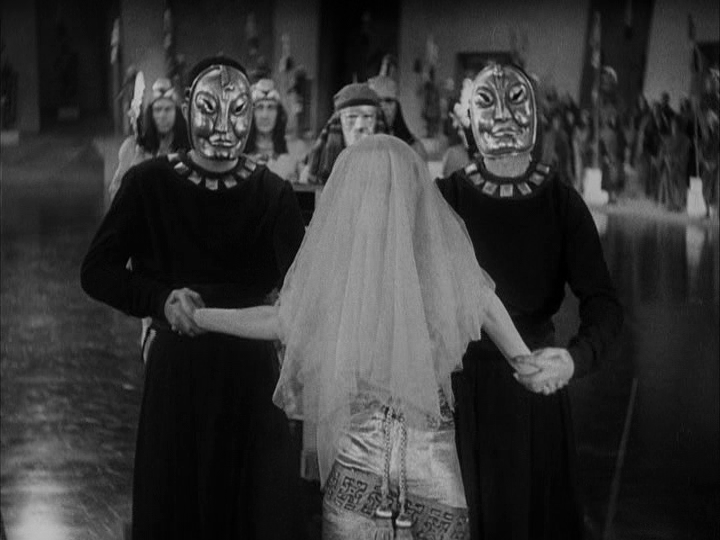
Note the Art Deco elements, even the classic reclining figure bathed in light and the throwback to classical elements of Greek theatre.
The second is less well done in general. The sets and costumes aren't as stunning or original. Even though the 1965 version followed the novel more closely (for instance, it's actually in Africa this time instead of the arctic), I don't feel it had quite the cinematic power of the 1935 version. That, of course, is not to slight the excellent performances by Peter Cushing and Christopher Lee, two of the greatest horror actors of all time. It's also not meant to slight the beauty of the unearthly Ursula Andress, who commands attention as Ayesha.


The real key to the success of the film is the character of Ayesha. Ursula Andress, though a fine actress in her own right, couldn't radiate the eternal passion of immortal tragic love and furious devotional jealousy—the pure lust for living that Helen Gahagan reveals. Helen's Ayesha is a tragic character of death with whom we fall in love, rather than Andress, who simply inspires desire. Her character is cold, calculating, lustful, and we cannot sympathize with her. She is two-dimensional, a goddess. Kallikrites/Leo ends up walking through the flame of eternal life, and simply waiting for Ayesha to be reborn once more, even shrugging off the love given to him by Ustane (played by the stunning Rosenda Monteros) that saved him in the first place. This is, I suppose, convenient for the sequel The Vengeance of She, but there's no real important lesson to learn, and we never establish enough connection with either Kallikrites/Leo or Ayesha to understand why the love is such a big deal. We do, however, feel adoration for Peter Cushing's Professor Holly, fright for Christopher Lee's Bilali, and sympathy for the gorgeous and sincere Ustane.

The captivating Helen Gahagan
The thing is, the 1935 version had a definite message. The message was that true love can only be had when one grows old and dies and "hopes to see them again someday." This message is conveyed through the naïve Tanya, who tries to dissuade Leo from walking through the eternal flame and uniting himself with Ayesha. Ayesha is revealed to be jealous beyond belief and vain enough to take joy in making Leo watch Tanya die without revealing her identity (thankfully he does, and ceases the sacrifice). This reveals that Ayesha does not so much want to make Leo hurt as much as she wants to satisfy her ravenous desire for his love for her to be complete. But Tanya thinks that Ayesha's type of love—the jealous obsession she has for her only equal, the only person "whose passion for life is as grat as [her] own"—isn't human. Instead, what love is to Tanya is simple. "Sharing life...growing old together, and when one dies, hoping to see them again someday."
This is a complex argument, and essentially implies that to truly love something, you must love something that is dying. Love and death. This argument is implied in films like Groundhog Day, in plays like Shakespeare's Hamlet, and in Wagner's Tristan und Isolde. Roger Scruton has a book about this very association.
In other words, whereas the 1965 film is a great film to watch if you are a Peter Cushing or a Christopher Lee fanboy (as am I), or just want to see Ursula Andress—it's always worth it. But really, it is an unsuccessful movie, especially if compared with the 1935 version directed by Cooper. Despite the minor characters being truly two-dimensional, Ayesha played by Helen Gahagan is a truly rich character with a depth that engages with themes that have been central to our literature since time immemorial: the terrible consequences of vanity, the horror of immortality, and the ephemeral nature of true love.
~~~
I think that the "star" system of rating movies is highly inadequate. I look for different things in movies, so I would rate them on different scales. Here is what I propose: To take different aspects of the movie, and give ratings for each one, with no overall "score." Judge the movie based on what it trying to do, not what you were wanting. That system works surprising well for a lot in life.
Here's what the numbers generally mean.
1 - objectively deplorable
2 - terrible
3 - bad
4 - below average
5 - mediocre
6 - could use improvement
7 - enjoyed it despite reservations
8 - great, with minor problems
9 - incredible
10 - inspired by genius or supernatural occurrence
For the 1935 version of Merian C. Cooper's She:
Main Character ~ 8
Supporting Characters ~ 6
Cinematography ~ 7
Set and Costume ~ 7+
Plot ~ 6+
Dialogue ~ 6
Music ~ 6+
Narrative Concern ~ 8
Effects ~ 6
The 1965 version of She:
Main Character ~ 6
Supporting Characters ~ 7+
Cinematography ~ 6
Set and Costume ~ 7
Plot ~ 6
Dialogue ~ 7
Music ~ 5
Narrative Concern ~ 5
Effects ~ 6
Further note: I have not watched the silent version from 1925, nor have I watched The Vengeance of She. I will review those at a later time in connection with this post.
Saturday, May 5, 2012
Well, This is Awkward...
I haven't updated in a long time. If any of you care, sorry.
My thesis, The Kingdom without God: Post-Apocalyptic Survival Narratives and the American Religious Imagination, is finished. Because I now know a little too much about science fiction, I would like to dedicate this blog—at least temporarily—to my burgeoning pulp fiction collection, and reviews of old science fiction movies. So anyway.
I went to the wonderful 1/4 Price Books today on Shepherd. The guy who runs the store was incredibly kind, helpful, and interesting. But I found three cool sci-fi books that were really great discoveries. They are easy to buy online, but not in this condition! These are not scans—I found these images online. Thanks to whoever uploaded them.
First, the Ace double novel books (two whole books in one!): Stepsons of Terra by Robert Silverberg and A Man Called Destiny by Lan Wright. This book is from 1958 and is in fair condition. The beginning pages are loose and the spine is torn, but it's Robert Silverberg, and it's quite old—so I thought I'd buy it.
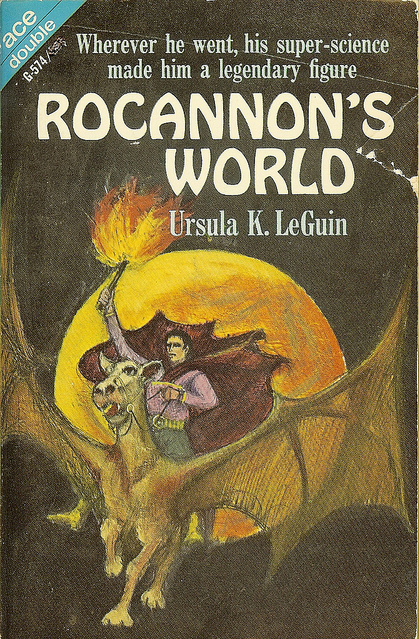
The next find is pretty special—it's the first edition of Ursula K. LeGuin's Rocannon's World. Since this one is also an Ace Double paperback, it also includes The Kar-Chee Reign by Avram Davidson. This one's from 1966 and is in near perfect condition—never been read. The Rocannon's World was originally published in Weird Tales, but the first full-length novel was published alongside Davidson's novel.


My thesis, The Kingdom without God: Post-Apocalyptic Survival Narratives and the American Religious Imagination, is finished. Because I now know a little too much about science fiction, I would like to dedicate this blog—at least temporarily—to my burgeoning pulp fiction collection, and reviews of old science fiction movies. So anyway.
I went to the wonderful 1/4 Price Books today on Shepherd. The guy who runs the store was incredibly kind, helpful, and interesting. But I found three cool sci-fi books that were really great discoveries. They are easy to buy online, but not in this condition! These are not scans—I found these images online. Thanks to whoever uploaded them.
First, the Ace double novel books (two whole books in one!): Stepsons of Terra by Robert Silverberg and A Man Called Destiny by Lan Wright. This book is from 1958 and is in fair condition. The beginning pages are loose and the spine is torn, but it's Robert Silverberg, and it's quite old—so I thought I'd buy it.


The next find is pretty special—it's the first edition of Ursula K. LeGuin's Rocannon's World. Since this one is also an Ace Double paperback, it also includes The Kar-Chee Reign by Avram Davidson. This one's from 1966 and is in near perfect condition—never been read. The Rocannon's World was originally published in Weird Tales, but the first full-length novel was published alongside Davidson's novel.

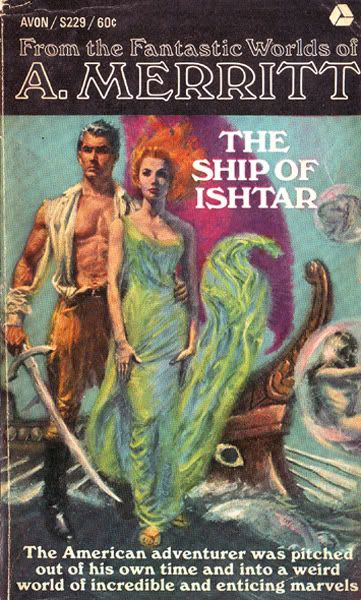
The last find was a real treat. It was unpriced, and caught my eye because of the condition—it has never been read, perhaps only touched a few times. It's the 1966 Avon publication (fourth printing) of The Ship of Ishtar by A. Merritt (Abraham Grace Merrit).
Avon S-229, cover artist Doug Rosa
Hope you enjoy the blog as it grows over the summer; I'm planning on reviewing a lot of old sci-fi movies and it might be worth your while to read them—especially if you would consider watching them.
Signing off for now,
R
Thursday, March 17, 2011
The Literary Qualities of Calvin & Hobbes
Nearly every intelligent person's favorite comic strip seems to be Calvin & Hobbes. Although I hesitate to include myself in the "especially intelligent" category, Calvin & Hobbes has been a presence in my life since I can remember. My first C&H book was "Revenge of the Baby-Sat," which is now in shreds, torn apart by overuse. I have since acquired nearly all of the published volumes, including the wonderful Tenth Anniversary Book, and the final word on C&H, the elephantine three-volume set The Complete Calvin & Hobbes.
I have been rather sick lately and instead of being a good Rice student and feverishly getting some readings done, I have glued much of my attention, once again, to the spiky-haired little boy and the sardonic stuffed tiger that so impressed upon me, at an early age, the importance of being a little wild. But the more I read of them, the more I realize that there is real substance there, a distinct anti-modernism and Epicurean outlook towards life that I did not have the faculty or the vocabulary to understand in my early years. Looking back, I wonder how subversive those funny panels really were, and if they made me what I am today in some subtle way (Epicurean and anti-modern). I think the duo would approve of their own actions, because, after all, "every good club needs a secret code!"
Bill Watterson, in his Tenth Anniversary Book, explicitly denied an ideological or philosophical connection to John Calvin or Thomas Hobbes. In fact, the pair seem to be the very opposites of their namesakes; Calvin is anything but unwaveringly moral, and Hobbes is distinctly anti-authoritarian. He even lets Calvin be the "Dictator-for-Life" in G.R.O.S.S (Get Rid Of Slimy girlS). But generally, the attitude of the strips both daily and Sunday are philosophical; meditating on the biggest and best questions and conundrums of modern life and thought. The most striking philosophical waxing happens in the wagon or on the sled, tumbling down hills, or walks in the forest looking for "weird stuff," or, my personal favorites, around the snowmen that Calvin insists are high art (that is, until he learns that he can sell them).
Watterson uses Calvin as the exemplar of our times. He is a child lost in his imagination and seems never to age, although many winters and school-years pass without a birthday. He dresses comfortably, hates his parents, but more sharply hates any authority figure, preferring to internalize them as monsters or aliens. Watterson uses Calvin's assertions to demonstrate how wrong he is about everything, or at least how ridiculous it is. But Calvin wouldn't mind this in the slightest—his willful obliviousness is the source of humor in the strip, and also the source of pathos; we know people who hold the same ridiculous positions as Calvin does (sometimes, scarily, he is ourselves). But Hobbes serves as the empathetic foil to Calvin's nihilistic philosophizing. He expresses himself as the quiet questioner, who really hammers in his point with a quip at the end of each dialogue. Perhaps this is Watterson himself talking. Who knows?
What philosophical issues does Watterson tackle? As I mentioned before, he runs the course, commenting on all the important questions of life and death: our relationship to the universe and each other, our relationship to animals and nature, literature, aesthetics, science, ethics, politics, economics, time, love, and on and on. He gives specific formats for the discussion of each one of these topics, and I'd like to go over them now with you, with some examples to boot. I think these are some of the most interesting and important (and distinctive) issues he deals with.
Science, Human Progress & the Cardboard Box:
Calvin's special Cardboard Box serves as everything science has ever dreamed of: the Transmogrifier, the Cerebral Enhance-atron, the Time Machine, the Duplicator, and anything that Calvin has a pressing need of. It seems that whenever he wants to get out of work, or bend the forces of nature, he uses his intense imagination to build some save-all contraption. But he always lands himself in far more trouble than he was in at first! It's also unimpressive (as Hobbes says, "scientific progress goes, 'Boink?!'"), and often destructive. Take for instance his creation of the "deranged mutant killer monster snow goon," which is a retelling of Frankenstein and the Sorcerer's Apprentice. Even though he defeats them eventually (by freezing the original snow goon and his mutant snowman creations with the garden hose) at considerable cost to his family (who have a yard covered in ice and weird snowmen), he refuses to learn the lesson, saying to Hobbes that the moral of the story is "Snow Goons are Bad News." When Hobbes points out the limited applicability of such an aphorism, Calvin replies, just like an impetuous scientist "I like maxims that don't encourage behavior modification.
What Watterson is commenting on here is the overwhelming arrogance of the scientific community messing with things they don't understand or control, like time and genes and mutant snowmen. It's a classic theme, with the same dire warning: we humans cannot delve into the mysteries of the universe without botching it, blundering as much as possible, and then refusing to learn the lesson. A distinctly anti-modern viewpoint, that, and one that suggests that humans in their current form are as good as we're gonna get without hurting ourselves. Stay out of the Cardboard Box, says Watterson.
So that's part one. Look out next week for a new theme chosen from Calvin & Hobbes.
Next Week: Warm Tapioca: Calvin and Television
Sunday, February 6, 2011
Imbolc 2011

I enjoy observing the passage of the year, it gives me grounding. Last year I taught a class on Neo-Paganism in Britain and America. I taught it from a highly skeptical perspective, one that spoke of my pagan friends affectionately, but dispassionately. I thought that it was just another manifestation of the great cultural washing-out, another aspect of a dying romanticism.
But I no longer think so. While the religion certainly has deep problems, I now see Neo-Paganism, especially Heathenism, Traditional and Progressive Witchcraft, and Druids, as a way of dealing with the problems of modernity without throwing out the good things about our generation. They keep the sense of community and ties to the land and rhythm with the seasonal changes and valuable crafts and knowledge, and still can be individualistic! Of course, not all Neo-Pagans are like that, but most at least have a sense of it. Am I still speaking from outside the faith? The year has caught me in its whorl, just like the rolling prairies of Texas caught me as a child. Perhaps that's why I never really understood Christianity's strange antipathy to pagans. I see why, certainly, reading the accounts of martyrs. Not only that, but Christians originally kept the good things about paganism... why do you think Christmas is so important to us, and Easter? It gives us a base, keeps time from rolling steadily out of our minds. But recent Christianity took out all the Saints' Days, and all the festivals (because the were pagan), so what are we left with? Christmas and Easter and Halloween (although they're not sure if they like that one). That's not enough to build a calender around!
I will celebrate the wheel of the year throughout this entire year. I want to experience firsthand the grounding, the putting down of roots in time itself, the grasping of a spoke as the wheel turns inexorably forward. At least I'll know where I am.
Wednesday, January 26, 2011
Submissions to Rice Review & Rice Pudding
Three out of four submissions to Rice Review (R2) were chosen to be published: A short nonfiction called "Noble Savage," which is a condensed version of the "Ginny" chapter in Red Ochre and Cattle: Growing Up Texan, which I am writing. Two poems were chosen: "Odyssey" and "Ledge." "Odyssey" is about leaving Houston and going to Shiner, "Ledge" is about the lure and dangers of nihilism.
Rice Pudding is not going to start up this semester, unfortunately, but we're assembling a team and we hope to at least get started on the website soon. It's beginning to take shape!
My class (being taught about British Fantasy literature) is going well, magically in fact (pardon the pun).
And lastly, I have (re)discovered a really wonderful movie, called Sherman's March, which is a sort of documentary by Ross McElwee. It is an exploration of Southern Womanhood, and the difficulties of understanding and relating to it.
Anyway, that's all for now, because I'm feverish and I don't have the patience to pour more time into the transient, false universe that sometimes sends down ideas—what we all know as the internet.
In Conlusion:

Rice Pudding is not going to start up this semester, unfortunately, but we're assembling a team and we hope to at least get started on the website soon. It's beginning to take shape!
My class (being taught about British Fantasy literature) is going well, magically in fact (pardon the pun).
And lastly, I have (re)discovered a really wonderful movie, called Sherman's March, which is a sort of documentary by Ross McElwee. It is an exploration of Southern Womanhood, and the difficulties of understanding and relating to it.
Anyway, that's all for now, because I'm feverish and I don't have the patience to pour more time into the transient, false universe that sometimes sends down ideas—what we all know as the internet.
In Conlusion:

Thursday, December 2, 2010
Beginning Again
I have decided to pick up the strands of thought I left behind this summer, and continue with this blog, although the focus will obviously be different.
I like to write, and I like to travel, I like to taste, and I like to theorize.
Therefore, I propose to put some of my writing up here, and plans for adventures, and reviews of things I like, and theories about the thing that I care about most: What is religion, and what is its place in the development and life of man? I'll start today with beginning with a little bit of each.
~~~~~~~~~~~~~~~~~~~~~~~~~~~~~~~~~~~~~~~~~~~~~~~~~~~~~~~~~~~~~~~~~~~~
Writing Away:
Today, I submitted three poems and a creative essay to Rice Review (or R2), the literary magazine of Rice University. Next semester, my friend Travis (you can find his excellent pictorial blog here: http://withinthehedges.blogspot.com/) is hoping to start a news/opinion/literary magazine at Rice to rival the idiotic hipster-ish angst of the standard and the questionable quality of the Thresher (don't get me wrong—I love the Thresher, but there is a habit of bad writing). It will be called Rice Pudding. There is also a plan to emphasize the humanities students more, which I hope to get on board with.
Plans for adventures:
I miss England, especially Oxford-area and Cumbria, dreadfully. Those were some of the happiest weeks of my life, and I am so utterly grateful to those people who made it such an adventure. But, alas, there is so much of the world to see and I cannot spend my entire life squatting at James' house, hiking the lakes, drinking his grog, and beating his friends at Texas Hold'em. So, besides going back to Cumbria and doing just that, I have some plans for adventures ahead, some trips that I shall take before I die. Here are a few of them:
1. An icy trip to the North. To see the setting for Northern Paganism, Expeditious Bravery, and Philip Pullman's Imagination. I'd like to go to Norway, Iceland, Svalbard, and then take a boat up to the North Pole.
2. Hiking with a Bedouin in the Atlas Mountains. Hopefully I'll do this with James, someday. In the heat of summer, I'd like to start in Marrakech, and go Eastward through Morocco.
3. Trans-Siberian Railway journey. I'd like to stop at the main Russian cities, and see if I can find any villages with real live shamans, perhaps out of my way up in the really cold parts of Sibera.
4. A Horseback ride through the Alps. Like I'm running from a spectral pursuer, or delivering a message to a Gothic King, I want to ride from Northern Italy through ancient mountain passes to Switzerland, and then turn Southwest and end up in Monaco.
5. Finding my roots. I want to take a pilgrimage of sorts through the lands of my family's ancestors, through the Pyrenees with the Basques, to Normandy, to Germany to meet the Tiekens and Henkhaus' there, to England again, and research the records kept there.
6. The Danube on a boat. I'd like to take some companions and buy or rent a riverboat at the head waters of the Danube, and make our way to the Black Sea, where we'll sell it or turn around and head back. Eastern Europe here we come, the little Huck Finns of Hungary.
That's the major ones I have in mind. I wonder which will be first?
On Woody Allen:
I watched Woody Allen's Love and Death last night. My GOD, that was funny. I'm pretty sure that not many people would find it funny though. I've discovered that my sense of humor focuses on the absurd, whether it's absurdly stupid (with a tinge of class) like Monty Python, or absurdly smart, like Woody Allen and Groucho Marx. Perhaps that's why I like British comedy and generally am not a fan of modern American comedy. Brits focus on wit and absurdity, Americans focus on awkward situations and character flaws (not to mention flatulence and stereotypes). Woody Allen does both, in an unobtrusive way.
My class on Neo-Paganism has ended. It was a mild success, I feel like the students learned a lot, but since they were primarily my friends, we had a really hard time staying on topic. For the last class period we watched Noel Coward's Blithe Spirit which is a light comedy about ghosts and women and this one "hag-ridden" man. I also found that enormously funny.
Brideshead Re-Revisited
Tomorrow, I am doing a presentation in class about Evelyn Waugh's theories about the connection between sexuality and maturity and Roger Scruton's theories about sexuality and where the two intersect and disagree. I am bringing in my own conclusions about modern culture and the correlation between "constant revolution" and fear of permanence, and between the sexual liberation of the 60's and the fear of constraint, as I believe that certain passages in Brideshead Revisited point to an interesting conclusion of Waugh's that pre-dates, but somehow goes farther, than Roger Scruton does in his book Sexual Desire. Although I am not going to list my main points here, you are welcome to talk to me if you want to find out more about my "current epiphany" as my parents mockingly refer to these brief moments of clarity.
Anyway, that's the flavor that these will take hopefully as I move with you, O Reader, into the future. It might be a few days before I post another... It's finals-time at Rice, and with Christmas break (food, family, friends, and a fine-looking girl waiting patiently at home) on the horizon, it's hard to concentrate on Latin Translations and the social basis of Education. But, this hellish semester is drawing to a close, and I've learned my lesson... next semester, I'm taking fewer hours, dropping two majors (!), and no class is before eleven o'clock.
Huzzah.
~Ross Arlen~
I like to write, and I like to travel, I like to taste, and I like to theorize.
Therefore, I propose to put some of my writing up here, and plans for adventures, and reviews of things I like, and theories about the thing that I care about most: What is religion, and what is its place in the development and life of man? I'll start today with beginning with a little bit of each.
~~~~~~~~~~~~~~~~~~~~~~~~~~~~~~~~~~~~~~~~~~~~~~~~~~~~~~~~~~~~~~~~~~~~
Writing Away:
Today, I submitted three poems and a creative essay to Rice Review (or R2), the literary magazine of Rice University. Next semester, my friend Travis (you can find his excellent pictorial blog here: http://withinthehedges.blogspot.com/) is hoping to start a news/opinion/literary magazine at Rice to rival the idiotic hipster-ish angst of the standard and the questionable quality of the Thresher (don't get me wrong—I love the Thresher, but there is a habit of bad writing). It will be called Rice Pudding. There is also a plan to emphasize the humanities students more, which I hope to get on board with.
Plans for adventures:
I miss England, especially Oxford-area and Cumbria, dreadfully. Those were some of the happiest weeks of my life, and I am so utterly grateful to those people who made it such an adventure. But, alas, there is so much of the world to see and I cannot spend my entire life squatting at James' house, hiking the lakes, drinking his grog, and beating his friends at Texas Hold'em. So, besides going back to Cumbria and doing just that, I have some plans for adventures ahead, some trips that I shall take before I die. Here are a few of them:
1. An icy trip to the North. To see the setting for Northern Paganism, Expeditious Bravery, and Philip Pullman's Imagination. I'd like to go to Norway, Iceland, Svalbard, and then take a boat up to the North Pole.
2. Hiking with a Bedouin in the Atlas Mountains. Hopefully I'll do this with James, someday. In the heat of summer, I'd like to start in Marrakech, and go Eastward through Morocco.
3. Trans-Siberian Railway journey. I'd like to stop at the main Russian cities, and see if I can find any villages with real live shamans, perhaps out of my way up in the really cold parts of Sibera.
4. A Horseback ride through the Alps. Like I'm running from a spectral pursuer, or delivering a message to a Gothic King, I want to ride from Northern Italy through ancient mountain passes to Switzerland, and then turn Southwest and end up in Monaco.
5. Finding my roots. I want to take a pilgrimage of sorts through the lands of my family's ancestors, through the Pyrenees with the Basques, to Normandy, to Germany to meet the Tiekens and Henkhaus' there, to England again, and research the records kept there.
6. The Danube on a boat. I'd like to take some companions and buy or rent a riverboat at the head waters of the Danube, and make our way to the Black Sea, where we'll sell it or turn around and head back. Eastern Europe here we come, the little Huck Finns of Hungary.
That's the major ones I have in mind. I wonder which will be first?
On Woody Allen:
I watched Woody Allen's Love and Death last night. My GOD, that was funny. I'm pretty sure that not many people would find it funny though. I've discovered that my sense of humor focuses on the absurd, whether it's absurdly stupid (with a tinge of class) like Monty Python, or absurdly smart, like Woody Allen and Groucho Marx. Perhaps that's why I like British comedy and generally am not a fan of modern American comedy. Brits focus on wit and absurdity, Americans focus on awkward situations and character flaws (not to mention flatulence and stereotypes). Woody Allen does both, in an unobtrusive way.
My class on Neo-Paganism has ended. It was a mild success, I feel like the students learned a lot, but since they were primarily my friends, we had a really hard time staying on topic. For the last class period we watched Noel Coward's Blithe Spirit which is a light comedy about ghosts and women and this one "hag-ridden" man. I also found that enormously funny.
Brideshead Re-Revisited
Tomorrow, I am doing a presentation in class about Evelyn Waugh's theories about the connection between sexuality and maturity and Roger Scruton's theories about sexuality and where the two intersect and disagree. I am bringing in my own conclusions about modern culture and the correlation between "constant revolution" and fear of permanence, and between the sexual liberation of the 60's and the fear of constraint, as I believe that certain passages in Brideshead Revisited point to an interesting conclusion of Waugh's that pre-dates, but somehow goes farther, than Roger Scruton does in his book Sexual Desire. Although I am not going to list my main points here, you are welcome to talk to me if you want to find out more about my "current epiphany" as my parents mockingly refer to these brief moments of clarity.
Anyway, that's the flavor that these will take hopefully as I move with you, O Reader, into the future. It might be a few days before I post another... It's finals-time at Rice, and with Christmas break (food, family, friends, and a fine-looking girl waiting patiently at home) on the horizon, it's hard to concentrate on Latin Translations and the social basis of Education. But, this hellish semester is drawing to a close, and I've learned my lesson... next semester, I'm taking fewer hours, dropping two majors (!), and no class is before eleven o'clock.
Huzzah.
~Ross Arlen~
Monday, August 9, 2010
Home with the Armadillo
I'm back in Texas, and remembering how wonderful and hot it is here (those two are unrelated).
I had a great time at the Goddess conference, but I couldn't wait to get home. Now the issue is writing this massive paper with proper citations and references.
The Goddess people were very kind, I had some wonderful experiences, and maintained my academic distance. I met some spectacular people that I hope to stay in contact with, and will look forward to a continuing dialogue.
Overall, my experience in England was magnificent. I love England as much as one would love a second home. It never felt like a foreign country, and not because of the shared language -- just because it seemed like I had been waiting to be there my entire life.
Thank you to Focus Europe, my family, my girlfriend, and the communities and individuals in England that welcomed me into the fold.
~Ross Arlen~
I had a great time at the Goddess conference, but I couldn't wait to get home. Now the issue is writing this massive paper with proper citations and references.
The Goddess people were very kind, I had some wonderful experiences, and maintained my academic distance. I met some spectacular people that I hope to stay in contact with, and will look forward to a continuing dialogue.
Overall, my experience in England was magnificent. I love England as much as one would love a second home. It never felt like a foreign country, and not because of the shared language -- just because it seemed like I had been waiting to be there my entire life.
Thank you to Focus Europe, my family, my girlfriend, and the communities and individuals in England that welcomed me into the fold.
~Ross Arlen~
Friday, July 30, 2010
Long-Delayed Post.
So, where was I?
Ah, yes... Bath. Yes, I got to meet the archaeologists that work on the Roman Baths, and we had a great conversation about all kinds of stuff. They were extremely kind and very helpful. After Bath I went to Bristol, where I stayed with an excellent host and had some good times. I then met with Ronald Hutton for an hour, and I got along with him very well. He said just enough to really clear up my findings for me, which really helped with my research, as it was getting quite confusing. I stayed quite a while in Bristol, because my host was so great, but after a gigantic Texas Pork/Beef/Chicken barbecue, a hectic morning, and a stressful bus fiasco, I went to Wells, where the Wells Cathedral is, and spent the day exploring the town and trying in vain to find the archivist who had agreed to meet me about Joycelin de Wells, who the "History of the Welles Family in England" names as part of the family, but who was 1.) probably not Norman, and 2.) came from a different part of the country. So, complicated issues in family history. Anyway, the cathedral was amazing and although I refuse to put pictures up (it is unbelievably tedious on this website), my facebook has pictures of all of my adventures up to now.
After Wells, I stayed a day in Glastonbury, which was...interesting. Glastonbury is one of the strangest places I have ever been in my life. Magic shops line every street, bookstores hold subjects everywhere from yogic techno dancing to witchcraft and animal health. Anyway, more on that later.
I then decided to go into Cornwall, or die trying. I got to Plymouth the first day and spent some time wandering around the docks, and had a surprisingly emotional experience at the Mayflower steps, due to the dreary atmosphere and the very dignified memorial to the Pilgrim Fathers. I left the next morning with an English breakfast in my belly to go to Falmouth. It was a really beautiful if touristy town, with great art everywhere, great fish, great beaches (the hostel I stayed in was 100 meters from the largest beach), and a great Tudor castle. At the hostel, I also met some really nice fellow travellers; and we were having a funny conversation on the porch about accents and language, when we realized that there was a German, a Frenchwoman, two Swiss girls, a Texan, and an Englishman at the same table! Quite international, that conversation. The next day, I visited the castle (Penriddis) and had a great conversation with the girl who ran the castle shop, who advised me to go to Boscastle Witchcraft museum instead of trying to get to Glastonbury that day. So, instead of going all the way back to Plymouth (and then on to Glastonbury) with my charming new French companion, we separated at Truro and I headed to North Cornwall, which took longer than I thought! Not only that, but I got to Boscastle JUST in time to be admitted into the museum, which was amazing. Boscastle is really atmospheric, eerie, and beautiful. I could definitely live there. It seems like a good place to have a witchcraft museum.
But, I couldn't stay there for the night--the hostel was full. I had to go to nearby Tintagel, and thank God for the long English days, because Tintagel is beautiful. I went (long) after hours to Tintagel castle, and climbed to the amazing island, but the real treat was the hostel, which was perched on a cliff overlooking the sea. As the sun set, I thought to myself, Cornwall has won me over. It was absolutely magnificent with the rugged coast and the little coves and the ancient buildings and the very low cell-phone service.
But, Tintagel is much farther from Glastonbury than I thought. It took me till almost six o'clock to get to Glastonbury, just in time for the opening ceremony of the Goddess conference.
The Goddess conference. I've had some good and clarifying conversations with many of the New Agers and Neo-Pagans here in Glastonbury, but the Goddess conference just beats all. I have to say I was a little scared by the opening ritual, but as I continue to participate (I'm not really doing any of the events today, as they are all self-help sorts of things, and that doesn't tell me anything except that there are a lot of women here), there are a lot of things that I feel very comfortable doing and thinking about.
More on the Goddess conference later. Suffice to say, Glastonbury is just a different place altogether.
Today, I am going to be working on my research and personal notes and perhaps perusing some more book stores, where I could spend hours and hundreds of dollars. But, to be honest, no matter how cynical a view I may take of some of the things here, I really love it here in Avalon.
Ah, yes... Bath. Yes, I got to meet the archaeologists that work on the Roman Baths, and we had a great conversation about all kinds of stuff. They were extremely kind and very helpful. After Bath I went to Bristol, where I stayed with an excellent host and had some good times. I then met with Ronald Hutton for an hour, and I got along with him very well. He said just enough to really clear up my findings for me, which really helped with my research, as it was getting quite confusing. I stayed quite a while in Bristol, because my host was so great, but after a gigantic Texas Pork/Beef/Chicken barbecue, a hectic morning, and a stressful bus fiasco, I went to Wells, where the Wells Cathedral is, and spent the day exploring the town and trying in vain to find the archivist who had agreed to meet me about Joycelin de Wells, who the "History of the Welles Family in England" names as part of the family, but who was 1.) probably not Norman, and 2.) came from a different part of the country. So, complicated issues in family history. Anyway, the cathedral was amazing and although I refuse to put pictures up (it is unbelievably tedious on this website), my facebook has pictures of all of my adventures up to now.
After Wells, I stayed a day in Glastonbury, which was...interesting. Glastonbury is one of the strangest places I have ever been in my life. Magic shops line every street, bookstores hold subjects everywhere from yogic techno dancing to witchcraft and animal health. Anyway, more on that later.
I then decided to go into Cornwall, or die trying. I got to Plymouth the first day and spent some time wandering around the docks, and had a surprisingly emotional experience at the Mayflower steps, due to the dreary atmosphere and the very dignified memorial to the Pilgrim Fathers. I left the next morning with an English breakfast in my belly to go to Falmouth. It was a really beautiful if touristy town, with great art everywhere, great fish, great beaches (the hostel I stayed in was 100 meters from the largest beach), and a great Tudor castle. At the hostel, I also met some really nice fellow travellers; and we were having a funny conversation on the porch about accents and language, when we realized that there was a German, a Frenchwoman, two Swiss girls, a Texan, and an Englishman at the same table! Quite international, that conversation. The next day, I visited the castle (Penriddis) and had a great conversation with the girl who ran the castle shop, who advised me to go to Boscastle Witchcraft museum instead of trying to get to Glastonbury that day. So, instead of going all the way back to Plymouth (and then on to Glastonbury) with my charming new French companion, we separated at Truro and I headed to North Cornwall, which took longer than I thought! Not only that, but I got to Boscastle JUST in time to be admitted into the museum, which was amazing. Boscastle is really atmospheric, eerie, and beautiful. I could definitely live there. It seems like a good place to have a witchcraft museum.
But, I couldn't stay there for the night--the hostel was full. I had to go to nearby Tintagel, and thank God for the long English days, because Tintagel is beautiful. I went (long) after hours to Tintagel castle, and climbed to the amazing island, but the real treat was the hostel, which was perched on a cliff overlooking the sea. As the sun set, I thought to myself, Cornwall has won me over. It was absolutely magnificent with the rugged coast and the little coves and the ancient buildings and the very low cell-phone service.
But, Tintagel is much farther from Glastonbury than I thought. It took me till almost six o'clock to get to Glastonbury, just in time for the opening ceremony of the Goddess conference.
The Goddess conference. I've had some good and clarifying conversations with many of the New Agers and Neo-Pagans here in Glastonbury, but the Goddess conference just beats all. I have to say I was a little scared by the opening ritual, but as I continue to participate (I'm not really doing any of the events today, as they are all self-help sorts of things, and that doesn't tell me anything except that there are a lot of women here), there are a lot of things that I feel very comfortable doing and thinking about.
More on the Goddess conference later. Suffice to say, Glastonbury is just a different place altogether.
Today, I am going to be working on my research and personal notes and perhaps perusing some more book stores, where I could spend hours and hundreds of dollars. But, to be honest, no matter how cynical a view I may take of some of the things here, I really love it here in Avalon.
Friday, July 16, 2010
Splish Splash Bath
Bath is a tourist hotspot. I have met more Americans in the last two days than I have the entire rest of my trip. Don't get me wrong -- it's nice to hear 'bar' for once instead of 'pub,' but I am in England and I didn't expect anyone I met to say "skeedaddlin'" until I got home. I met a movie producer from South Carolina who had a helicopter crash and decided to go to England while they were repairing it. He was really interested in my research and he had some frightening stories about escapades with strange people in the deep bayous of Louisiana. Then I met a group of girls coming to the hostel where I'm staying that are from Texas State! Of course, none of them are from Texas (no Twang available). Then this morning at a nice Tea Room I met someone from Northern Michigan that raises bucking bulls for rodeos. Okay.
I've been trying to squeeze Bath like a sponge, and my wallet unfortunately reflects that fact today. I've been on the Bath Abbey tour, on the Roman Bath tour, on the Jane Austen Center tour. I've been to four different pubs, tea rooms, and pasty shops. I'm going back to the Baths later tonight when they light it up with torches. Plus, a 10 pound note dropped out of my pocket. Alas!
However, I have been talking to people an unusual amount even for myself, and I am about to meet the site administrator for the Roman Baths to talk more in-depth about the religion at the Bath temple, at the reccommendation of the tour guide yesterday. He said that she might even take me on a personal tour of the tunnels under the sacred spring. Let's see how charming I can be.
I'm staying at a hostel again tonight, but I'm tiring of the wierd shopping culture at Bath. I might go to Bristol sometime soon. Ronald Hutton has agreed to meet with me on Tuesday (for an hour), so I'm naturally excited about that as well. TTFN.
I've been trying to squeeze Bath like a sponge, and my wallet unfortunately reflects that fact today. I've been on the Bath Abbey tour, on the Roman Bath tour, on the Jane Austen Center tour. I've been to four different pubs, tea rooms, and pasty shops. I'm going back to the Baths later tonight when they light it up with torches. Plus, a 10 pound note dropped out of my pocket. Alas!
However, I have been talking to people an unusual amount even for myself, and I am about to meet the site administrator for the Roman Baths to talk more in-depth about the religion at the Bath temple, at the reccommendation of the tour guide yesterday. He said that she might even take me on a personal tour of the tunnels under the sacred spring. Let's see how charming I can be.
I'm staying at a hostel again tonight, but I'm tiring of the wierd shopping culture at Bath. I might go to Bristol sometime soon. Ronald Hutton has agreed to meet with me on Tuesday (for an hour), so I'm naturally excited about that as well. TTFN.
Thursday, July 15, 2010
Where I am in mind, spirit, body.
There is no easy answer to the question referred to above. Let's work backwards, shall we?
Bodily I am in Bath. Not the hot relaxing cleaning time at the end of a day walking in the rain, but the city: Bath Spa. I made it here last night after missing my bus to Bristol. Let me explain.
I last left you, oh fair readers, in the mountains of Cumbria. Well, to make short a story that could be quite long, suffice to say that my new friend James had a Couchsurfer coming on Wednesday. I didn't want to be a burden to his excellent hospitality any longer, AND I wanted to get to London to see the Harry Potter premiere. However, on the 12th, after looking online for an hour hoping to buy an advance ticket, I found that I had misinformed by two people, completely separately from each other, that Harry Potter was indeed premiering on July 14th in London. After reviewing the mistake, I found that they had confused July 14th 2010 with July 14th 2011, when the second installment of the last part was to be premiered in London. The first installment premieres November 19th.
So I had now purchased a ticket to London for no reason. What's more, I had been waiting for the number of 'the London contact' for a few days now, and had still not recieved the message. James offered to drive me to Newcastle and to spend the day around Hadrian's wall, which was excellent. We apparently can't go anywhere without hiking! I got on my bus and on the 8-hour drive I tried to arrange a place for me to stay and was successful, thanks to my wonderful teacher and her son. I got to London at 10:30 pm and after navigating the metro, finally got to his house at around 11:45. We stayed up talking for a while, because he is really an incredible guy. The problem was, his parents-in-law (also incredibly nice) were coming the next day, so I decided to book a ticket to Bristol, which was the next place I was going anyway. The next morning, I met his lovely wife (named the same as my girlfriend, so it got confusing when we were talking about it!), and his beautiful daughter. But I left at around five for Victoria station, hoping to get to Bristol in time to sort out a bed and breakfast before eight.
It was not to be. I got to the station just in time for my bus to leave. When I tried to get on it, however, another family went out with me and made it to the ticket man before me. He looked at her ticket and said, "Sorry, it's a funfare...I can't let you board yet." Well, mine was a funfare, too! I went inside and it was already past the time for the bus to leave, then the time changed to thirty minutes after. Apparently it was delayed. Oh well, I thought, I'll get a pasty and wait here. So I waited only to find out after I got in the line for the already late bus that my ticket was invalid--I had missed my bus! Not only that, but I had to buy another ticket! And it was going to be a full hour later! Turns out that the family was asking if she could board early for the next bus. A legitimate but frustrating mistake on my part.
Well, I thought, how in the world am I going to get accomodation in Bristol this late for a reasonable price? A couchsurfer had given me his number in Bath in case of an emergency situation (he already had a surfer), and at this point, there was no way I could find a place to stay at that late for any less than £70. So I called him, and he said it was fine, gave me directions, etc. Go to Bristol train station, get on a train to Bath, and a bus to the University.
When I got to Bristol it was 10:20. All buses had stopped running to the train station, and both the cab drivers and the bus drivers told me that trains had stopped running to Bath anyway. There was a bus leaving at 11:00 for Bath, so I got on that. But I didn't get to Bath in time to catch a bus to the University, so I had to hire a cab. I got there at 12:10, then slept on the floor of his flat.
So, in spirit, I'm a bit down right now. I've got a ton of aches and cricks and I'm tired of lugging the backpack around. I'm probably staying at a backpacker's hostel tonight in Bath.
Not only that, but Ronald Hutton is not in Bristol right now, and I might not get to meet personally with him at all -- it might have to wait for Skype, like Roger Griffin. Well, this library computer is £3.60 an hour, so I probably should go. I'll upload pics from Hadrian's wall later and also inform you about the state of my research (mind). I want to go visit the Roman buildings around Bath (excited!), that will surely cheer me up. Maybe there's even a Mithraeum! We'll see.
Ross
Bodily I am in Bath. Not the hot relaxing cleaning time at the end of a day walking in the rain, but the city: Bath Spa. I made it here last night after missing my bus to Bristol. Let me explain.
I last left you, oh fair readers, in the mountains of Cumbria. Well, to make short a story that could be quite long, suffice to say that my new friend James had a Couchsurfer coming on Wednesday. I didn't want to be a burden to his excellent hospitality any longer, AND I wanted to get to London to see the Harry Potter premiere. However, on the 12th, after looking online for an hour hoping to buy an advance ticket, I found that I had misinformed by two people, completely separately from each other, that Harry Potter was indeed premiering on July 14th in London. After reviewing the mistake, I found that they had confused July 14th 2010 with July 14th 2011, when the second installment of the last part was to be premiered in London. The first installment premieres November 19th.
So I had now purchased a ticket to London for no reason. What's more, I had been waiting for the number of 'the London contact' for a few days now, and had still not recieved the message. James offered to drive me to Newcastle and to spend the day around Hadrian's wall, which was excellent. We apparently can't go anywhere without hiking! I got on my bus and on the 8-hour drive I tried to arrange a place for me to stay and was successful, thanks to my wonderful teacher and her son. I got to London at 10:30 pm and after navigating the metro, finally got to his house at around 11:45. We stayed up talking for a while, because he is really an incredible guy. The problem was, his parents-in-law (also incredibly nice) were coming the next day, so I decided to book a ticket to Bristol, which was the next place I was going anyway. The next morning, I met his lovely wife (named the same as my girlfriend, so it got confusing when we were talking about it!), and his beautiful daughter. But I left at around five for Victoria station, hoping to get to Bristol in time to sort out a bed and breakfast before eight.
It was not to be. I got to the station just in time for my bus to leave. When I tried to get on it, however, another family went out with me and made it to the ticket man before me. He looked at her ticket and said, "Sorry, it's a funfare...I can't let you board yet." Well, mine was a funfare, too! I went inside and it was already past the time for the bus to leave, then the time changed to thirty minutes after. Apparently it was delayed. Oh well, I thought, I'll get a pasty and wait here. So I waited only to find out after I got in the line for the already late bus that my ticket was invalid--I had missed my bus! Not only that, but I had to buy another ticket! And it was going to be a full hour later! Turns out that the family was asking if she could board early for the next bus. A legitimate but frustrating mistake on my part.
Well, I thought, how in the world am I going to get accomodation in Bristol this late for a reasonable price? A couchsurfer had given me his number in Bath in case of an emergency situation (he already had a surfer), and at this point, there was no way I could find a place to stay at that late for any less than £70. So I called him, and he said it was fine, gave me directions, etc. Go to Bristol train station, get on a train to Bath, and a bus to the University.
When I got to Bristol it was 10:20. All buses had stopped running to the train station, and both the cab drivers and the bus drivers told me that trains had stopped running to Bath anyway. There was a bus leaving at 11:00 for Bath, so I got on that. But I didn't get to Bath in time to catch a bus to the University, so I had to hire a cab. I got there at 12:10, then slept on the floor of his flat.
So, in spirit, I'm a bit down right now. I've got a ton of aches and cricks and I'm tired of lugging the backpack around. I'm probably staying at a backpacker's hostel tonight in Bath.
Not only that, but Ronald Hutton is not in Bristol right now, and I might not get to meet personally with him at all -- it might have to wait for Skype, like Roger Griffin. Well, this library computer is £3.60 an hour, so I probably should go. I'll upload pics from Hadrian's wall later and also inform you about the state of my research (mind). I want to go visit the Roman buildings around Bath (excited!), that will surely cheer me up. Maybe there's even a Mithraeum! We'll see.
Ross
Sunday, July 11, 2010
Bilberry Fields
Today, after a huge Texas breakfast (crunchy bacon and fried eggs in the bacon grease, which James has renamed 'heart attack'), James and I decided that rather than laze around the house until the Sunday poker game, why not go for a "stroll," intead? Well, as you can imagine, the stroll soon turned into a full-scale excursion.
We first went t a small hill that James had often seen when he went running in this particular valley, in a place called Ennerdale. We got over the hill, tramping huffily throught the bracken, and admired the view. Then, we looked up—there was a gigantic, imposing hill right across the stream in the dip of the valley. We decided to skip the hill and instead head up the rock face. But that was only after eating from bilberry bushes. They're almost exactly like blueberries, except wild, smaller and sweeter. We munched on those delicious things for a while, and then followed a small new looking stream up to its source. When we got to the spring, you could hear it under the rocks trickling. The sound was incredible. Onwards!
We soon discovered that the hill was much larger than we had first thought. The climbing was excellent! Imagine climbing almost sheer rock faces, gripping spots where the mountain bleeds clear spring water, sprouting black spongy moss, which makes it hard to hold onto! As we struggled up the cliff, and finally reached the top of the first face, we let out a whoop and it echoed across the valley. The view was beautiful, but it was the climb that made it so worthwhile. It was truly challenging. Then, after a rest and bilberries, we made the ascent to the second face, through the scree (loose rock and rubble) that made it extremely difficult to get to the top. Finally we reached the base, and up we went. There was one point where we lost sight of each other due to climbing two different faces, and when I got to the top, James wasn't there! I feared the worst and called his name. He didn't answer, and I almost panicked. I knew that he was an experienced climber, but anything can happen! I slid down a grassy stream bed, still calling out, but I heard no reply. When I had reached the bottom again, I still saw or heard nothing. So up I went again, this time up an easier face, panicked and out of breath. Finally, I saw him. Turns out the wind had been carrying my voice to him, but his voice was lost to the wind. We had been chasing each other around the same face for 15 panicked minutes! Any tourist with binoculars would have thought we were cartoon characters.
After resting our panic, we finally climbed to the summit. What a sight! I could see Scotland, the North Sea, and the Isle of Man from where I stood (it only came out so-so in pictures). We had landed ourselves in a high bog, and James stepped in a nasty rotting swamp-hole, but it was worth it as we ascended to the high cairn and admired our incredible climb. We then walked down the mountain ridge and then through a bracken slope into a small pine forest, and followed that to the path that led us back to the car. Finished the night off with an unsuccesful but fun game of Hold'em.
Anyway, I was misinformed (by two separate people, no less!) about the Harry Potter premiere. But the ticket has already been purchased, and on Monday we are travelling to Hadrian's wall and then on to Newcastle, where I will catch a train to London. What will I do in London? Beats me. I'm going to be skipping Scotland this trip, unfortunately. It's just that, well... I love England. After London, I'm going to Cornwall! Can't wait for that.
Here are the pictures from today's climb.








We first went t a small hill that James had often seen when he went running in this particular valley, in a place called Ennerdale. We got over the hill, tramping huffily throught the bracken, and admired the view. Then, we looked up—there was a gigantic, imposing hill right across the stream in the dip of the valley. We decided to skip the hill and instead head up the rock face. But that was only after eating from bilberry bushes. They're almost exactly like blueberries, except wild, smaller and sweeter. We munched on those delicious things for a while, and then followed a small new looking stream up to its source. When we got to the spring, you could hear it under the rocks trickling. The sound was incredible. Onwards!
We soon discovered that the hill was much larger than we had first thought. The climbing was excellent! Imagine climbing almost sheer rock faces, gripping spots where the mountain bleeds clear spring water, sprouting black spongy moss, which makes it hard to hold onto! As we struggled up the cliff, and finally reached the top of the first face, we let out a whoop and it echoed across the valley. The view was beautiful, but it was the climb that made it so worthwhile. It was truly challenging. Then, after a rest and bilberries, we made the ascent to the second face, through the scree (loose rock and rubble) that made it extremely difficult to get to the top. Finally we reached the base, and up we went. There was one point where we lost sight of each other due to climbing two different faces, and when I got to the top, James wasn't there! I feared the worst and called his name. He didn't answer, and I almost panicked. I knew that he was an experienced climber, but anything can happen! I slid down a grassy stream bed, still calling out, but I heard no reply. When I had reached the bottom again, I still saw or heard nothing. So up I went again, this time up an easier face, panicked and out of breath. Finally, I saw him. Turns out the wind had been carrying my voice to him, but his voice was lost to the wind. We had been chasing each other around the same face for 15 panicked minutes! Any tourist with binoculars would have thought we were cartoon characters.
After resting our panic, we finally climbed to the summit. What a sight! I could see Scotland, the North Sea, and the Isle of Man from where I stood (it only came out so-so in pictures). We had landed ourselves in a high bog, and James stepped in a nasty rotting swamp-hole, but it was worth it as we ascended to the high cairn and admired our incredible climb. We then walked down the mountain ridge and then through a bracken slope into a small pine forest, and followed that to the path that led us back to the car. Finished the night off with an unsuccesful but fun game of Hold'em.
Anyway, I was misinformed (by two separate people, no less!) about the Harry Potter premiere. But the ticket has already been purchased, and on Monday we are travelling to Hadrian's wall and then on to Newcastle, where I will catch a train to London. What will I do in London? Beats me. I'm going to be skipping Scotland this trip, unfortunately. It's just that, well... I love England. After London, I'm going to Cornwall! Can't wait for that.
Here are the pictures from today's climb.








Subscribe to:
Posts (Atom)