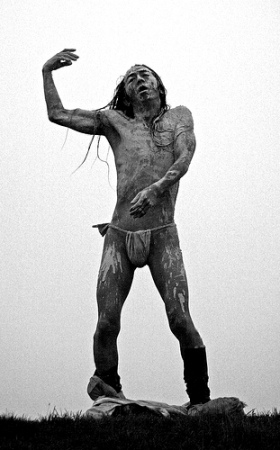
Pagan Journey, Pagan Soul
Neo-Pagan Pilgrimage, the Identity Odyssey, and the Quest for Non-Conformity
It took a great amount of time to decide to which of the two scholarships I should apply. The excellent and supremely helpful Kelly Butler informed me that the Leebron Smyth was oriented towards the needs of research proposals, while the Brotzen searched out a more personal journey. My summer travel aspirations fit completely into neither of these categories. However, I believe that the merit of my proposal lies in this fact. To restrict it to one category or another would, I believe, limit its possibility and make it less of what it is: a deeply personal journey of exploration into the heart of an academic interest.
I am planning to travel in the British Isles. Now, I am also aware, from viewing the previous applications to the Brotzen Award, that the board usually gives preference to countries outside of Western Europe. The preference is given to students who go “off the beaten tack,” as stated on the website. Again, I believe that my proposal virtually embodies that description, even if it does happen to focus on Western Europe.
All my life, I have been acutely aware, enthralled, even enchanted by the practices and beliefs of people that wildly differ from conventional worldviews. I have intentionally searched out friends with contrasting attitudes, practices, and passions. My family and professors alike will attest to my fascination with the ancient, the archaic, the disparate, the divergent. This, combined with an academic interest in pre-medieval and medieval religious practice, and a fascination with the religious and historical construction of identity, has culminated in a passionate fascination for Paganism, both ancient and modern. Ancient paganism is, of course, constrained to the written word, and cannot be experienced. But Neo-Paganism, the dynamic and diverse belief system that continues to grow (most prominently) in Britain and America virtually begs to be experienced, to be felt, to be studied from the inside. Even the students at Rice University, who on the whole I have found to be some of the most curious and engaging minds in the country, do not yet give this religion their full attention, and if they express opinions about it, they are usually negative, uninterested, or simply misinformed. Although I have devoted a great amount of time to the study of this extremely important religious movement, I feel that in order to truly comment on Neo-Paganism in the interest of increasing global-mindedness and diversity on the Rice campus (and indeed, in my entire sphere of acquaintance), I must experience the Pilgrimage of the Neo-Pagan, the journey into the Soul of the religion itself. In order to do this, I must go to the British Isles.
Ever since Gerald Gardener, author of Witchcraft Today and The Meaning of Witchcraft, founded one of the first covens (a congregation of witches) in England, it has been the center of the movement, with more than 50,000 people claiming to be “Pagan” in 2002 [http://www.bbc.co.uk/religion/religions/paganism/ataglance/glance.shtml]. That number is probably much larger, since many keep to themselves, but I think that it demonstrates the magnitude of the movement. What’s more, an estimated 21,000 people showed up when the British government allowed open access to Stonehenge on the summer solstice in 2006 (Sacred Sites, Contested Rites/Rights). That number, too, has increased. What draws these people to travel hundreds, sometimes thousands of miles to this mysterious structure? Many believe that it is in search of a forgotten past, an intangible heritage that resonates with Neo-Pagans and mainstream Brits alike. But is this a conscious act of nostalgia, or is it something deeper; a religious pilgrimage that calls across oceans and reaches into the souls and imaginations of Druids-at-heart across the globe? Stonehenge certainly calls me. And I must go.
I will begin at Stonehenge on the summer solstice at sunrise. There, I will begin to interview some of the thousands of people there, inquiring after their purpose in coming to Stonehenge. I will ask such questions as, “What does Stonehenge stand for to you?,” “How does the experience of traveling heighten the experience?,” and “Do you feel that you come for a more religious or historical reason?” These questions will not be so dryly worded, of course, because I want to come away with a better understanding of the population, not simply dry anthropological data. Rituals, such as binding-of-hands, the pagan marriage ceremony, will be carried out at Stonehenge as well, and I will ask what importance location and timing plays in the significance of the event. I will then travel to nearby Avebury by sunset, because a large amount of people travel there as well, where I will conduct the same interviews and record similar observations.
For the next month, not only will I travel to sacred sites (megaliths, dolmens, tombs, etc.) across England, Ireland, and Scotland, but I will interview the caretakers and groundskeepers of the sites, discovering why they keep watch over the sites, what kind of people they come into contact with, and similar data. I will lodge as much as I can with Neo-Pagans (for lodging arrangements, see below) and with the native population of Britain’s and Ireland’s countryside. I am intending to avoid large cities as much as possible, because I have a fierce love for the countryside, and want to really experience the rocks and the wind and fields, the moors and groves and hills! It is curious, and sad at the same time, that I have never visited the islands to which I devote my study and passion. The reason is simple: I have never had the chance to financially support travel across the pond. When I saw that I might have the opportunity to go to Britain without financial burden on my family, I immediately (I mean, within the hour!) jumped at the opportunity by arranging meetings with the study abroad office and the undergraduate fellowships office.
The pilgrimage will culminate in the 8-day “Goddess Conference” in Glastonbury, from July the 25th to August the 1st. Here is where I think I will receive the bulk of my data. The event includes festivals, ceremonies, feasts, worship, and general celebration. Hundreds of Neo-Pagans show up every year for the explicit purpose of honoring the Goddess, and I want to meet these people, and search to understand them. This, I think, demonstrates the value of my actual study; I don’t want to do what many researchers have done: fallen into the trap of attempting to define what Neo-pagans believe. I don’t specifically want to know that as much as I want to understand how Neo-Paganism is practiced. I think that this area has been neglected from a scholarly point-of-view, as most of the books commenting on Neo-Pagan practice are written by Neo-Pagans for Neo-Pagans, and while those texts accomplish their tasks very well, they are primary sources, not commentary, not study. This is what I want to accomplish, or, at least, contribute to: the study of Neo-Pagan practice in the British Isles. Among the main questions I will consistently ask are: What kind of religious practice is Neo-Paganism: Worshipful, Meditative, or Celebratory? Is it a combination of those, just like any other religion, or is it something completely different? What about the Neo-Pagan attitude towards other religions? Is the movement reactionary to what Neo-Pagans feel is the oppressive nature of conventional religion? Is the movement compensatory, trying to reclaim heritage that they feel has been lost? Is it truly a resurgence of ancient paganism as the mythical literature of the Neo-Pagans claim? Or is it, again, something completely different? I think that these are questions that need to be asked explicitly. I also think that the data that I will collect (interviews, observations, recordings, etc.) will be helpful to both the new student and more experienced religious scholars, of which I hope to become, even if I am not now.
This brings me to the value that this journey will have for me. As I have mentioned before, financial difficulties in my family have consistently obstructed me from traveling to Britain, Ireland, or Scotland. Indeed, I have only been to Mexico on two service trips, and to Canada with my grandmother. While I think this is normal for many people, it is deeply surprising to me that I have devoted my entire life to the study of Europe and have never been there. I too, want to claim the heritage that I have never felt. Last semester I was enrolled in the Rise and Fall of the Berlin Wall course, and simply learning the history of Germany (I am half German) seemed to fill a hole in me that I never knew was there. I am a quarter British, and I want to fill another hole, one that I can now feel acutely. As far as the academic, professional, and personal value that this will have for me, there is little difference between them; I desire more than anything to be a professor of religious history and heritage, and will therefore spend the rest of my life learning! Learning is my religion—not knowledge, but learning. The act, then, of traveling to the British Isles, the land that I love so much and that is so absent from me, is more than just a research proposal; even more than a personal adventure! It is an journey of learning, an odyssey of identity, a pagan pilgrimage.
Previous Research, Travel Plans, and other such odious details:
I am teaching a Hanszen college course next semester on Neo-Paganism to increase the spirit of diversity on campus and to share an academic and personal passion that I think I have demonstrated in my personal statement. If this trip were to be successfully funded, the experience would contribute greatly to the student’s learning experience and to my own knowledge as well as the ease in which I impart that knowledge to the students. In all, I believe this trip is important for me, because I will get considerable field experience in taking notes, keeping a journal, conducting interviews, and making observations. It will also give me much needed experience in the area of the practice of religious and cultural studies. It is also my opinion that the trip will benefit Rice and its students, because I will be sharing my findings with my professor Claire Fanger, who is frankly my academic mentor, John Stroup, for whom I am a research assistant and planning to write a survey of the politics of diversity, and with the Boniuk Center for Religious Tolerance, so that they may have information to increase awareness on campus and perhaps provide attractive events for campus Neo-Pagans. As I said before, this could also benefit Rice through the class I am planning to teach; cursory questions (to the student population) about the awareness of Neo-Paganism have been rather depressing—the only people who have known anything concrete about it were in the religious studies department. As I am planning to teach this course, I have read (and am planning to read) a great deal about the subject ranging from Neolithic Tombs and their religious significance to medieval magical practices to the modern construction of Pagan identity and the struggle for a religious tradition sensitive to the needs of the ecosystem and gender equality. Here is a list of books, separated by those I have read, those I have ordered in order to read, and those that I am planning to read* (Those bolded are especially important for my trip):
*Note: About a third of the books were recommended to me by Claire Fanger.
Anglo-Saxon Paganism by David Wilson
Claiming Sacred Ground: Pilgrims and Politics at Glastonbury and Sedona
by Adrian J. Ivakhiv
Drawing Down the Moon by Margot Adler
Earth Rites; Fertility Practices in Pre-Industrial Britain by Janet & Colin Bord
Gardener's Book of Shadows by Gerald Gardener
Magic in the Middle Ages by Richard Kieckhefer
Man and His Symbols by C.G. Jung
Sacred Sites, Contested Rites/Rights by Jenny Blain and Robert Wallis
The Ancient Art of Faery Magick by D.J. Conway
The Civilization of the Goddess by Marija Gimbutas
The Secret Teachings of All Ages by Manly Hall
The Hero With A Thousand Faces by Joseph Campbell
The Language of the Goddess by Marija Gimbutas
The Power of Myth by Joseph Campbell
The Rise of Magic in Early Medieval Europe by Valerie Flint
The Survival of the Pagan Gods; The Mythological Tradition and its Place in
Renaissance Humanism and Art by Jean Seznec
The Tomb of the Eagles; Life and Death in a Stone-Age Tribe by John Hedges
The Tribe of Witches by Stephen J. Yeates
The Witch of Portobello by Paulo Coelho
Christmas in Ritual and Tradition, Christian and Pagan by Clement A. Miles
Earthly Bodies, Magical Selves; Contemporary Pagans and the Search for Community by Sarah Pike
Mushrooms and Mankind: The Impact of Mushrooms on Human Consciousness and Religion by James Arthur
Persuasions of the Witch's Craft by T.M. Luhrmann
Rites of Pleasure: Sexuality in Wicca and Neo-Paganism by Jennifer Hunter
The Chalice and the Blade: Our History, Our Future by Riane Eisler
The Pagan Book of Days: A Guide to the Festivals, Traditions, and Sacred Days of the Year by Nigel Pennick
The Pagan Religions of the Ancient British Isles by Ronald Hutton
The Spiral Dance: A Rebirth of the Ancient Religion of the Goddess by Starhawk
The Triumph of the Moon; A History of Modern Pagan Witchcraft by Ronald Hutton
Unwrapping Christmas by Daniel Miller
Blood and Mistletoe: The History of the Druids in Britain by Ronald Hutton
Buckland’s Complete Book of Witchcraft by Raymond Buckland
Goddess Spirituality for the 21st Century by Judith Laura
The Myth of the Goddess: Evolution of an Image by Anne Baring & Jules Cashford
Wicca: A Guide for the Solitary Practitioner by Scott Cunningham
Travel, Lodging, Living Expenses:
As you have gathered, I am pressed for money. Therefore, I want to make this trip as inexpensive as possible by backpacking through the isles. My airfare and travel within the Isles (buses, trains, ferries, etc.) will be the largest expense, but I plan to walk much of the way—this is an integral part of the experience for me. Also, when there are sites that are close together I will simply ask for a ride. This will cut the costs, but it is still significant. As far as lodging goes, there is a website—couchsurfing.com—that arranges lodging with families and students for free. It has been recommended to me by friends who have had similar experiences in Europe. I will, if necessary, stay at hostels, and I am also planning to sleep outdoors in the countryside if the weather allows. I have calculated the expense to include lodging in hostels for 40 days to avoid miscalculation. I can live (food-wise) on relatively little and this is also calculated below. I also will need equipment (namely, light recording equipment) and I have factored that in as well.
Tentative Budget
(All are maximum estimates)
Flight from Houston to London via AirCanada or JetBlue or similarly low-priced airfare (round trip), and travel throughout Britain App. $2000.00
Lodging in England for 40 days
This will include hostels, staying with families arranged on couchsurfing.com, and camping in the countryside. App. $1250.00
Living Expenses estimated at $25.00 a day App. $1000.00
Miscellaneous expenses: App. $350.00
Total: $4,600
Thank you for your consideration. If there is any other information I can give you at my email address, rossarlen@gmail.com